
CONSUMED BY MISERY UP ON HELL'S HALF ACRE, the true story.
by Richard Lee Cook
MOST ORIGINAL MAGIC SYSTEM BOOKY
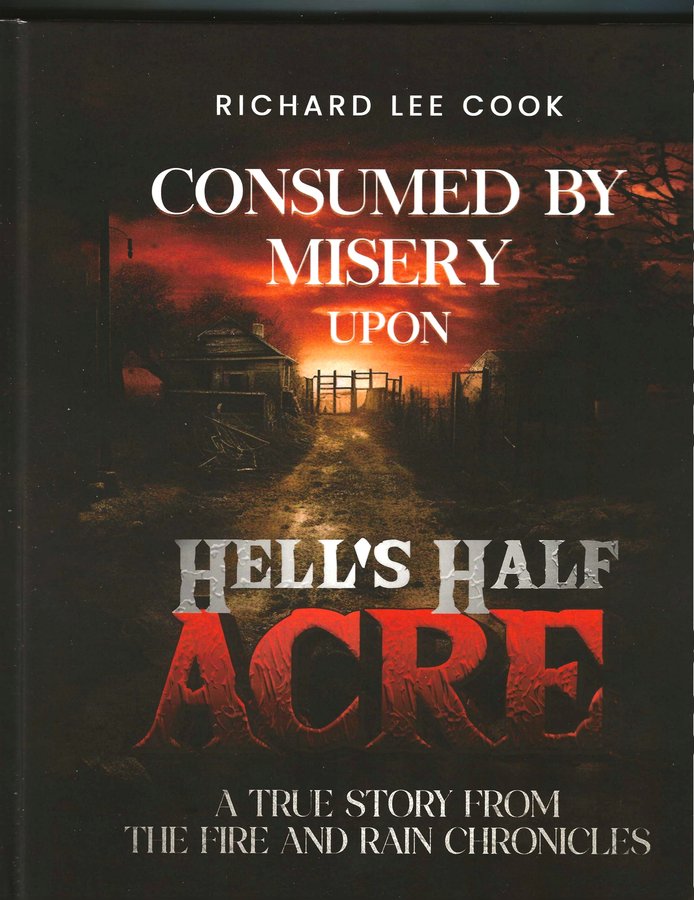
The judge's reasoning
Cook's memoir earns its place on the strength of place — the lived, textured hell of "Hell's Half Acre" itself. This isn't abstract trauma-writing; it's a specific rural Maryland poverty rendered in unforgettable detail: the outhouse "humorously named 'Bessie-May,'" the winter piss-pots, the creek baths, the father's own coinage that when it snowed it was "asshole deep to a twelve-foot Indian." These details do the work that the more purple passages ('a thousand tiny beings racing through my veins') can't — they make you smell the place, not just feel bad about it.
The emotional core lands hardest in the funeral chapter, where present-tense grief keeps splintering into flashback. The mother's dying instruction — "Lee, take Bonnie and yourself and get the hell out of that house" — is delivered with no ornamentation and hits harder than the surrounding prose because of it. So does the small, unadorned moment with cousin Betty-Lou's hand on his shoulder, which does more grounding work in two lines than pages of interior monologue around it.
Where the book struggles is architecture: a 306-chapter table of contents that folds a poetry collection into a memoir spine makes it hard to know what book you're reading, and the prose leans hard on inherited literary flourish (Faulkner, Shakespeare epigraphs) that sits awkwardly against the raw vernacular of the abuse scenes, which are the book's actual voice. But the testimony itself — a child dissociating into a wheat-field refuge with an imagined twin named Chance, a mother rising 'like a vengeful force of nature' — has the texture of something actually lived and finally said out loud. That's worth recognizing.

Judged by Arthur Beaumont — Non-Fiction · Memoir · Business · Self-Help
"A good non-fiction book changes one specific thing about your week."
Supporting passages
"In our world, with no plumbing indoors, we relied on an old outhouse humorously named "Bessie -May.""
A single concrete, specific detail that grounds the poverty of the setting more effectively than pages of abstraction.
"Lee, take Bonnie and yourself and get the hell out of that house. Far away from your father!"
The mother's dying words, delivered plainly, carry more weight than the surrounding ornamented prose.
Per-axis rubric scores
Every Booky-winning book is scored across all ten craft axes. The award category comes from the top axis; a second axis at or above 75 appears as secondary recognition.
Find out what your book does best.
Submit your book today. Get a real, honest, category-specific Booky — or every dollar back.
Submit Your Book → Screen Another Book