
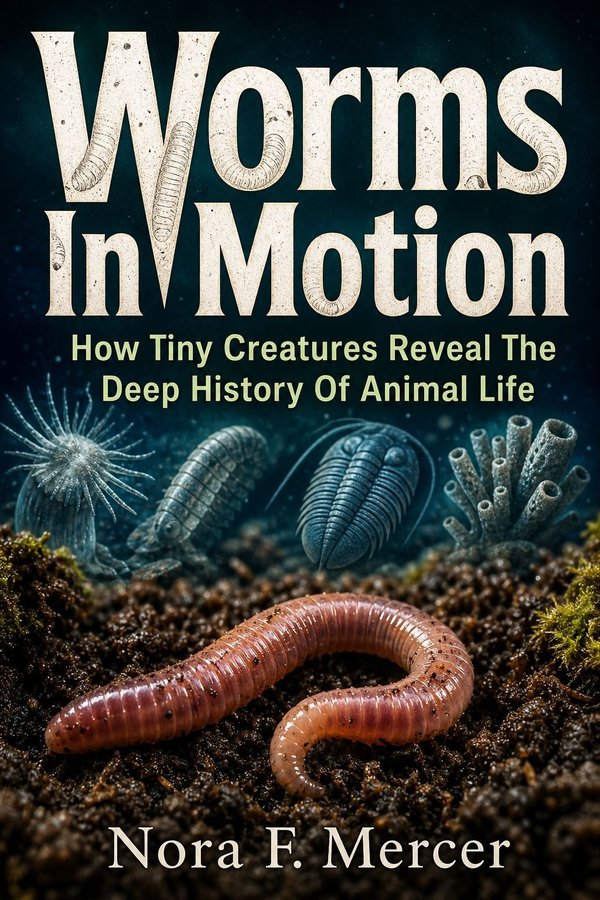
Worms in Motion
by Nora F. Mercer
BEST TREATMENT OF IDENTITY BOOKY
Takes you to this book's Amazon page.
The judge's reasoning
Mercer's real strength is conceptual: she has chosen a genuinely useful organizing idea — that 'worm' is a body plan, not a lineage — and she returns to it with discipline rather than decoration. The book earns its keep in moments like the distinction between homology and convergence, and in the closing sections of Chapter 2, where trace fossils are treated not as curiosities but as evidence: 'the fossil is not a portrait but a sentence in the language of motion.' That line does real work — it reframes a groove in ancient mud as a legible record of behavior, which is exactly the kind of specific, teachable insight a popular-science reader wants to walk away with.
The argument structure supports this substance well. Each chapter builds a rung of the ladder — why simplicity is diagnostic, how movement reorganizes a body's relationship to its environment, how symmetry and segmentation solve distinct mechanical problems — without skipping steps or assuming prior expertise. The recurring insistence that 'simple' does not mean 'primitive' is not just a rhetorical tic; it's the spine of the book's thesis, and it is defended with concrete mechanism (hydrostatic skeletons, cephalization, neuromodulation) rather than assertion alone.
Where the manuscript falls short of its own ambition is rhythm — the prose often restates its central claim in slightly rotated language across paragraphs, and the qualifying hedges ('likely,' 'may have,' 'in that sense') pile up until momentum stalls. But for a reader who came for the ideas rather than the sentences, this is a book that delivers what it promises: a rigorous, well-sourced case for taking small, soft-bodied animals seriously as evidence, not afterthought.

Judged by Eleanor "Nell" Whitcombe — Literary Fiction · Prose & Style
"A sentence either earns its breath or it doesn’t."
Supporting passages
"A worm is not just a small animal. It is a test case for understanding what happens when life becomes active, directional, and physically engaged with the world."
States the book's organizing thesis with precision and sets up the argument that follows.
"In each case, the fossil is not a portrait but a sentence in the language of motion."
A rare moment where the science writing achieves real figurative economy, turning trace-fossil evidence into a legible record of behavior.
"The challenge is to tell those routes apart."
A characteristic closing beat that converts an expository chapter into an open question, keeping the argument moving forward.
Per-axis rubric scores
Every Booky-winning book is scored across all ten craft axes. The award category comes from the top axis; a second axis at or above 75 appears as secondary recognition.
Find out what your book does best.
Submit your book today. Get a real, honest, category-specific Booky — or every dollar back.
Submit Your Book → Screen Another Book