
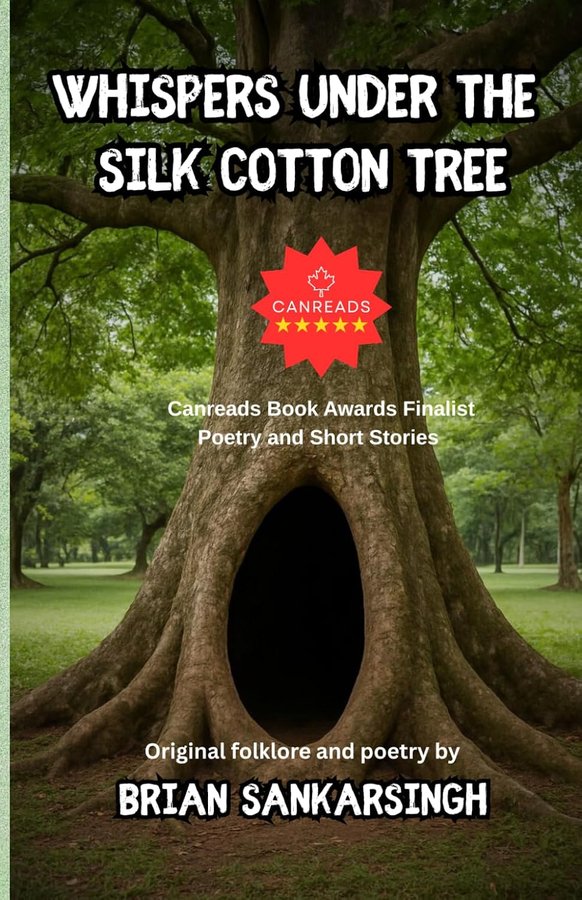
Whispers Under the Silk Cotton Tree
by Brian Sankarsingh
MOST SENSORY WORLDBUILDING BOOKY
Takes you to this book's Amazon page.
The judge's reasoning
Sankarsingh's real gift here is atmosphere built from cultural specificity rather than invented lore. The Douen's backward feet, the soucouyant's folded skin "resting in a large mortar," the Heartman's hearse that "moved no faster than a crawl, but always close, as though the road itself bent to its will" — these details aren't decorative, they're doing the work folklore is supposed to do: making the uncanny feel procedural, almost bureaucratic in its inevitability. The book's true strength is how thoroughly it renders a Trinidad that is at once geographically real (Moruga, Guanapo, the Northern Range, cane fields and silk cotton trees) and spiritually porous, where obeah men, jumbies, and Papa Bois exist within the same social fabric as Diwali celebrations and pepper roti limes.
The prologue's argument — that folklore is "coded forms of philosophy, resistance, and psychology," that the soucouyant tale once policed "envy, jealousy, and power left unguarded in the night" and can now be reread as a parable of selfhood — gives the collection an intellectual spine that elevates it above simple ghost-story retelling. "Papa Lucien's Plans Go Awry" and "Rohan and the Jumbie" both use their supernatural machinery to deliver genuinely felt moral consequence: obsession curdles, greed for power (Papa Neezer) or fame (Rohan) gets punished by forces older and wiser than the human appetite for control.
The prose itself is uneven — dialogue tags stumble, some sentences run past their natural stopping point — but the world these stories inhabit is vivid, specific, and clearly loved. That's a real strength, and it's the one worth naming.

Judged by Eleanor "Nell" Whitcombe — Literary Fiction · Prose & Style
"A sentence either earns its breath or it doesn’t."
Supporting passages
"He knelt and gently poured cool water from his gourd into the creature's mouth. "Easy now, lil' one," he said, voice like thunder wrapped in velvet. "I been sleeping for too long. What are they doing to mih forest?""
Papa Bois rendered as both mythic guardian and tender caretaker, grounded in dialect that locates the tale precisely in place.
"A tale of the soucouyant, for example, was once a strict warning to women about envy, jealousy, and power left unguarded in the night. Today, retold, it can also become a parable of freedom, a metaphor for selfhood slipping through cracks in the cage of expectation."
The prologue articulates a genuine critical framework for why these retellings matter beyond nostalgia.
Per-axis rubric scores
Every Booky-winning book is scored across all ten craft axes. The award category comes from the top axis; a second axis at or above 75 appears as secondary recognition.
Find out what your book does best.
Submit your book today. Get a real, honest, category-specific Booky — or every dollar back.
Submit Your Book → Screen Another Book