
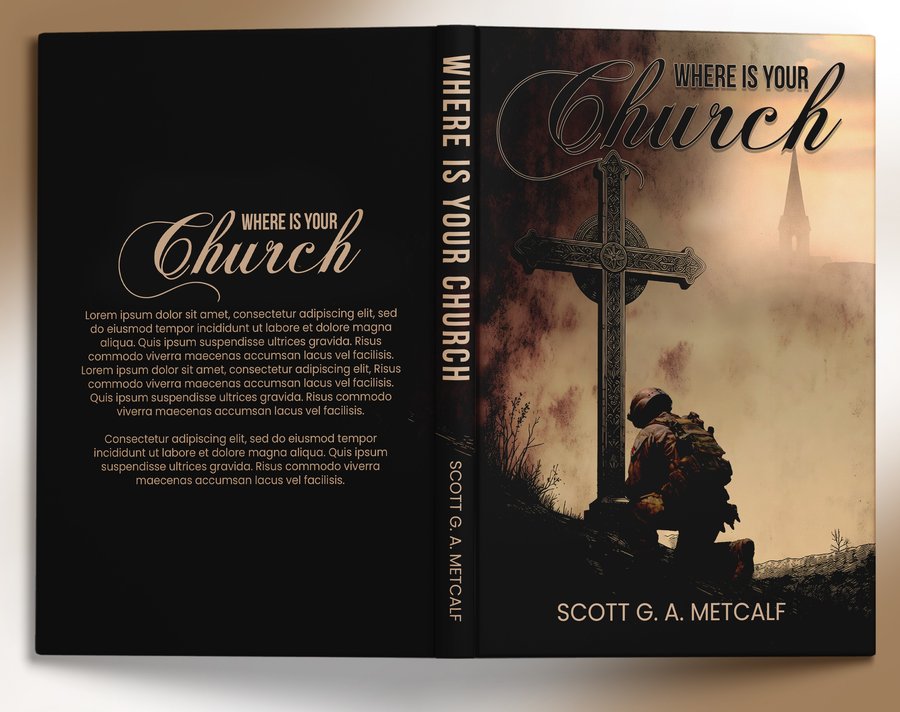
Where is your church
by Scott G. A. Metcalf
BEST TREATMENT OF POWER BOOKY
The judge's reasoning
Where Is Your Church earns its recognition on Theme & Substance because it does something genuinely difficult: it holds a specific moral argument — that ministry is presence, not pronouncement — and it demonstrates that argument scene by scene rather than merely stating it. Metcalf's central act of discipline is the withheld Bible. He carries it into every encounter, and repeatedly chooses not to deploy it, letting the casserole and the coffee do the theological work first. That restraint is the book's most honest insight, and it lands.
The characterizations of Smitty and Marcus are spare but real — Smitty's measured "Appreciate it, friend," the word friend hanging "tentative, unearned," is the kind of observation that shows a writer actually listening. Duke's admission — "Used to have a house. A wife. Kids. Now… now I got this" — is unadorned and sufficient; it doesn't reach for more than the moment offers.
The World-Building axis earns secondary recognition because the sensory rendering of San Antonio's underpass ecology is the book's most sustained achievement: the "symphony of survival" — plastic sheeting, paint-bucket seats, the damp-earth smell cut by cheap coffee — accumulates into a credible, specific environment that readers who have never been there can inhabit.
The prose occasionally over-explains what the imagery has already shown (the internal dawnings repeat across chapters), and structural momentum is loose. But the book's substance — what it costs to show up, what trust looks like when it's been stripped of expectation — gives working readers in the faith-and-service space something genuinely worth sitting with.

Judged by Eleanor "Nell" Whitcombe — Literary Fiction · Prose & Style
"A sentence either earns its breath or it doesn’t."
Supporting passages
"The Bible remained in my bag. I felt a subtle resistance in the air, a sense that introducing religious discourse too soon would be a mistake. These men had likely encountered well-meaning people before, people who had tried to 'save' them with scripture, offering spiritual solace when their bellies were empty and their bodies ached from the cold."
This moment of deliberate restraint is where the book's central argument — that authentic ministry prioritizes human dignity over doctrinal agenda — becomes concrete rather than rhetorical.
"A discarded paint bucket, its interior meticulously cleaned, might serve as a seat. A collection of plastic bottles, filled with water, could be stacked to create a rudimentary shelving unit. An old, dented metal briefcase, found by the side of the road, might hold precious belongings, a tangible link to a past that felt increasingly distant. The sheer ingenuity was breathtaking, a stark contrast to the helplessness that often defined their outward circumstances."
The accumulation of specific scavenged objects builds the underpass world from the ground up, letting the improvised order speak to resilience without the author having to name it.
""Appreciate it, friend." The word "friend" hung in the air, tentative, unearned."
Two words of dialogue followed by three of authorial observation — this is Metcalf at his most economical, capturing the exact texture of provisional trust without sentimentalizing it.
Per-axis rubric scores
Every Booky-winning book is scored across all ten craft axes. The award category comes from the top axis; a second axis at or above 75 appears as secondary recognition.
Find out what your book does best.
Submit your book today. Get a real, honest, category-specific Booky — or every dollar back.
Submit Your Book → Screen Another Book