
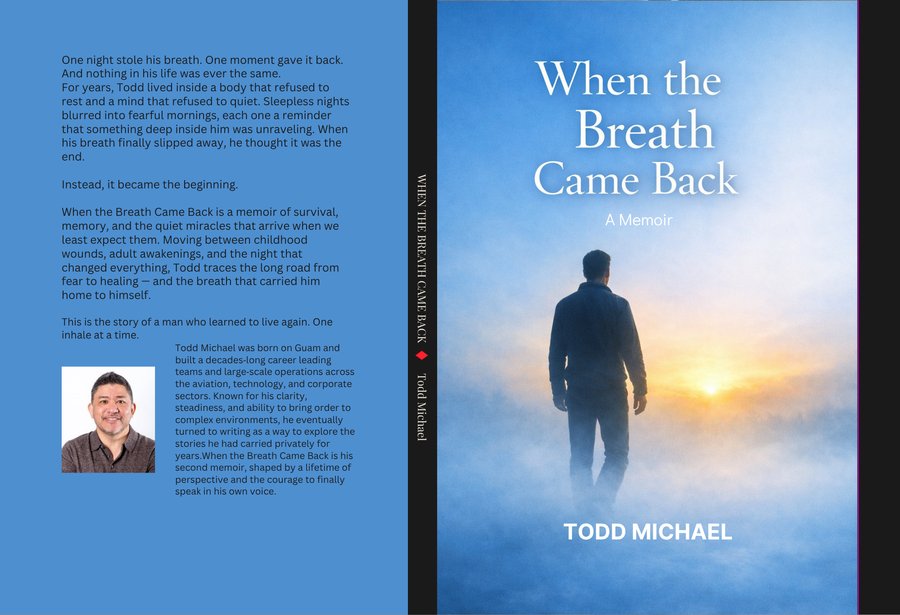
When The Breath Came Back
by Todd Michael
MOST COMFORTING READ BOOKY
The judge's reasoning
Todd Michael's strength here is the felt, embodied re-creation of hypervigilance — he doesn't just describe fear, he stages its physiology chapter after chapter, and that specificity is what earns the emotional payoff. The recurring motif of breath (held as a child, lost as a man, monitored obsessively after the heart attack) gives the memoir a structural spine that a lot of trauma narratives lack. The image of the boy behind his cracked bedroom door adjusting the hallway light "like tuning a radio to the barely-safe frequency" is genuinely well-observed — it's a detail no ghostwriter invents, only someone who lived it.
The dogs — Charli, Franki, Tucker — are the book's best structural decision. Deploying comic relief ("a pile of snoring, shedding, emotionally supportive furniture") directly after a pill-counting scene keeps the memoir from collapsing into unrelenting misery, and it works because the comedy is specific rather than generic. That tonal control — grief and absurdity on the same page — is harder to pull off than it looks, and Michael manages it more than once (the "terrified burrito" line under the blanket-as-forcefield bit lands the same way).
Where the book is less disciplined is in argument: the connective tissue between chapters ('all of it traces back to that first night') is asserted more than demonstrated, and the prose leans on repetition-as-emphasis (short-sentence tricolons appear on nearly every page) to a point of diminishing returns. But for readers who've lived inside undiagnosed sleep apnea or complex-PTSD hypervigilance, the visceral rendering of counting pills at 2:14 a.m. and gripping a steering wheel in a parking lot will land exactly where it's aimed.

Judged by Arthur Beaumont — Non-Fiction · Memoir · Business · Self-Help
"A good non-fiction book changes one specific thing about your week."
Supporting passages
"I was not afraid of the dark. I was afraid of what the dark had taught me."
A clean, earned turn that reframes the chapter's fear as learned rather than innate.
"Franki had climbed on top of me, staring down with the intensity of a therapist who charged by the minute."
Specific, lived sensory detail that makes the domestic world of the memoir concrete and distinctive.
"It did not slam into me. It slipped quietly, the way chilly air sneaks under a doorframe — subtle at first, then impossible to ignore."
An image that does real descriptive work rather than simply restating the theme.
Per-axis rubric scores
Every Booky-winning book is scored across all ten craft axes. The award category comes from the top axis; a second axis at or above 75 appears as secondary recognition.
Find out what your book does best.
Submit your book today. Get a real, honest, category-specific Booky — or every dollar back.
Submit Your Book → Screen Another Book