
BookyAwards · 2026
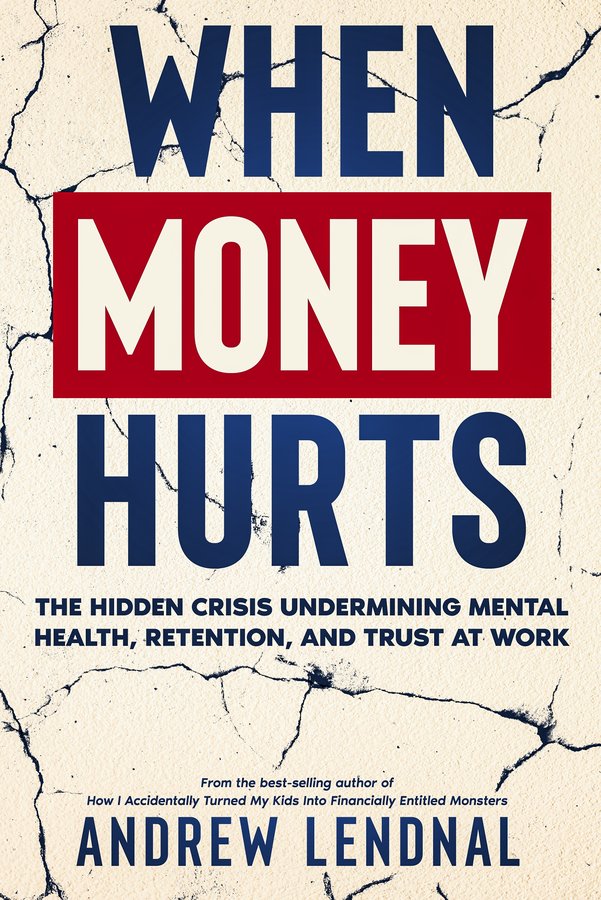
When Money Hurts: The Hidden Crisis Undermining Mental Health, Retention, and Trust at Work
by Andrew Lendnal
Most Actionable Business Booky
Retailer link provided by the author.
The citation
The judge's reasoning
Lendnal's strength is that he treats financial wellness as a workplace problem to be diagnosed rather than a perk to be sold. The core argument is stated plainly in Chapter 3: "Financial stress is not a knowledge problem. It's an emotional problem." Nearly every chapter follows from it. Programs fail because they chase clicks instead of confidence, launch without embedding, and mistake education for relief. That is a real thesis, and it is why Chapter 2 can say with a straight face that a wellness program "isn't competing with other benefits. It's competing with exhaustion."
The book earns its practicality in three ways. First, the Part One history (post-war pensions to the 401(k), housing exclusion, the financial-literacy gap) explains why employees are stressed before it tells employers what to do. Second, the playbook is specific and usable: the four foundations in Chapter 4, the seven-pillar strategy in Chapter 11, and a 90-day rollout timeline and vendor checklist in the appendices. Third, Chapter 8 does something most business books avoid. It connects financial distress to suicide risk, and it pairs that with concrete employer actions that stop short of playing therapist.
The author's own story anchors the abstraction: a New Zealander and a finance professional who found U.S. benefits enrollment bewildering, which tells the reader that if he felt overwhelmed, the average employee will too. The "Truth Bomb / Bonus Tip" scaffolding is repetitive, and some statistics are loosely sourced, but the book does what it promises. An HR leader finishes it knowing what to change in their program this quarter.
From the book
Supporting passages
"Financial stress is not a knowledge problem. It's an emotional problem."
"Your nancial wellness program isn't competing with other bene ts. It's competing with exhaustion."
"We handed people a maze — and no map."
The scorecard
Per-axis rubric scores
Every Booky-winning book is scored across all ten craft axes. The award category comes from the top axis; a second axis at or above 75 appears as secondary recognition.
- Prose & Style 77
- Characterization 74
- Dialogue 70
- Plot & Structure 79
- World-Building 79
- Originality 77
- Emotional Resonance 80
- Theme & Substance SECONDARY RECOGNITION 87
- Genre Execution AWARDED 86
- Marketability & Hook 85
Scores out of 100
Find out what your book does best.
Submit your book today. Get a real, honest, category-specific Booky — or every dollar back.
