
Vic High @ 150!
by Helen Edwards
MOST SENSORY WORLDBUILDING BOOKY
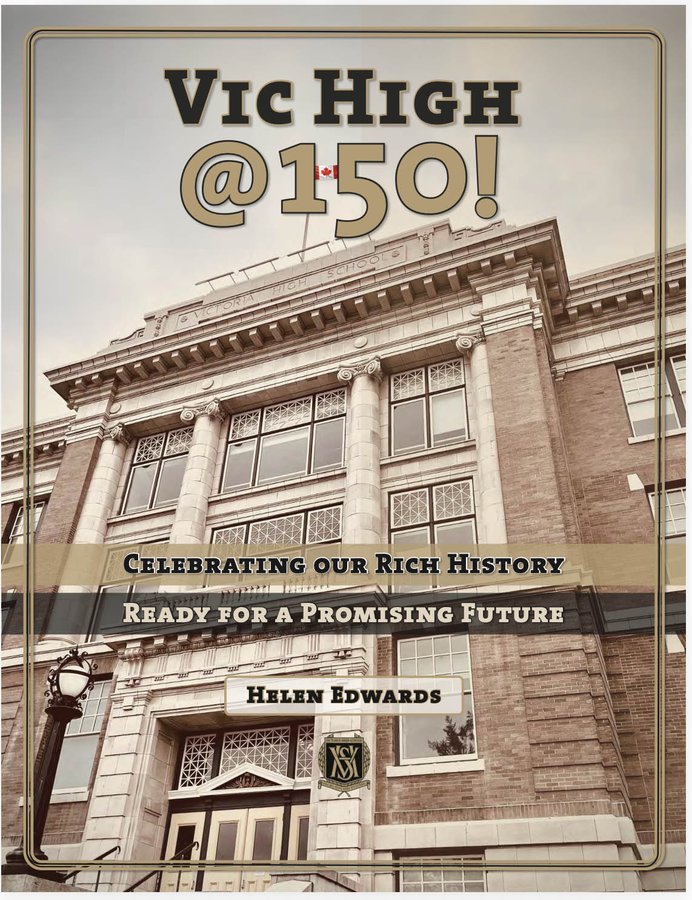
The judge's reasoning
Helen Edwards has written the kind of institutional history that succeeds by accretion rather than narrative flourish, and the axis where this pays off is World-Building — here, the lived, textured sense of a specific school across five decades. She doesn't just report dates; she reconstructs the felt experience of the place: locker rooms converted to classrooms because of overcrowding, a 13-degree slope in the Fairey Tech floor as the building sinks into the ground, a bridge sawn out of six feet of stage space so students could cross without walking through the audience. These are small, physical, verifiable details, and they accumulate into a genuine sense of Vic High as a building that breathes, decays, and gets patched — not an abstraction.
The book's real strength is knowing that a school's history is inseparable from its people, and Edwards keeps finding the human anecdote inside the bureaucratic record: Bridie Rapson breaking into tears in a bank line because she never learned to balance a chequebook, then earning her Grade 12 at 34; Maude, the 81-year-old "single raging granny" building her own coffin as a woodworking project. These moments are unpolished but genuine, and they do the job any institutional history needs to do — they make the reader feel the place mattered to actual people, not just to a school board's balance sheet.
As Genre Execution, this is exactly what a commemorative alumni history should be: heavily sourced (Times Colonist, Daily Colonist citations throughout), inclusive of the messy administrative detail (seismic reports, PERC cards, union concessions) that gives the book its documentary credibility for the audience that will actually buy it — Vic High alumni. It knows its reader and serves them faithfully.

Judged by Arthur Beaumont — Non-Fiction · Memoir · Business · Self-Help
"A good non-fiction book changes one specific thing about your week."
Supporting passages
"the Fairey Tech roof and floor at the autobody end sloped to a 13° angle as the building sank into the ground"
A concrete physical detail that makes the building's decline tangible rather than abstract.
"One day, I was standing in line at the bank. I had gotten married at 19, had four kids over the next seven years, and broke into tears in that lineup because I had no idea how to make a deposit"
A well-chosen personal anecdote that humanizes the adult-education statistics and shows the author's instinct for finding story inside institutional record.
Per-axis rubric scores
Every Booky-winning book is scored across all ten craft axes. The award category comes from the top axis; a second axis at or above 75 appears as secondary recognition.
Find out what your book does best.
Submit your book today. Get a real, honest, category-specific Booky — or every dollar back.
Submit Your Book → Screen Another Book