
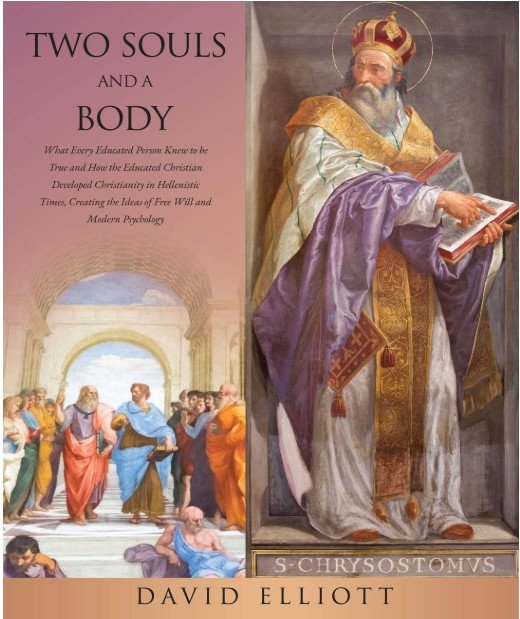
TWO SOULS AND A BODY: What Every Educated Person Knew to be True and How the Educated Christian Developed Christianity in Hellenistic Times, Creating the Ideas of Free Will and Modern Psychology
by David Elliott
BEST TREATMENT OF REDEMPTION BOOKY
Takes you to this book's Amazon page.
The judge's reasoning
Elliott's dissertation-turned-book has a genuine, load-bearing argument, not a vibe: that the Hellenistic 'two souls and a body' psychology — inherited from Egyptian ba/ka, refracted through Plato's Timaeus, and passed through Philo, Plutarch, the Neo-Pythagoreans, the Chaldaean Oracles, the Hermetica, Nemesius, Marcus Aurelius, and finally Chrysostom — is the actual ancestor of modern free will and cognitive psychology. That's a big claim, and he earns it the hard way, with primary-source citation and Greek terminology rather than assertion.
What elevates this past a dry survey is the preface, where he cashes the argument in personally: 'I finally lost a substantial amount of weight by telling myself that feeling hungry did not require me to eat... hungry feelings are GOOD. It means I'm losing weight!' That's the tripartite theory of choice-over-impulse applied to his own body, and it's followed by a client with arachnophobia deciding the hallucinated spiders 'could be ignored as imaginary; and, if small, could be stepped on and killed' — CBT before CBT, he argues, and he's not wrong to notice the lineage.
The book also builds a real sense of the intellectual world it describes — Homer's watery eidolon versus the fiery gods, Plutarch stashing the blood-soul on a watery moon because he's a priest of Apollo and wants both souls in heaven, the tetractys as a 'geometric proof of God.' It's a lived cosmology, oddly rendered but consistently rendered. The prose is often unwieldy and the digressions (Yehud coinage, a T-Rex sci-fi trilogy) will lose some readers, but the underlying scholarship and the specific, applicable payoff — ancient tripartition as usable psychology — is real and worth the award.

Judged by Arthur Beaumont — Non-Fiction · Memoir · Business · Self-Help
"A good non-fiction book changes one specific thing about your week."
Supporting passages
"I finally lost a substantial amount of weight by telling myself that feeling hungry did not require me to eat, but could be thought of as hungry feelings are GOOD. It means I'm losing weight!"
A concrete, personal demonstration of the book's central claim that ancient tripartite psychology functions as usable practical technique.
"The wraith or eidolon is a vaporous, watery soul, while the immortal gods are fiery lights like stars."
A precise, sensory rendering of how the Hellenistic cosmos actually felt and looked to the people who inhabited it.
"The space travelling T-Rexes battle Earth's robots! The T-Rexes descended from caimans represent the pre-Minoan Cycladic matriarchal civilization of Greek mystery religions."
An unmistakably idiosyncratic authorial voice that refuses to sound like a standard academic monograph.
Per-axis rubric scores
Every Booky-winning book is scored across all ten craft axes. The award category comes from the top axis; a second axis at or above 75 appears as secondary recognition.
Find out what your book does best.
Submit your book today. Get a real, honest, category-specific Booky — or every dollar back.
Submit Your Book → Screen Another Book