
Turning Black Ink Into Gold
by Toby Tatum
MOST RESONANT MESSAGE BOOKY
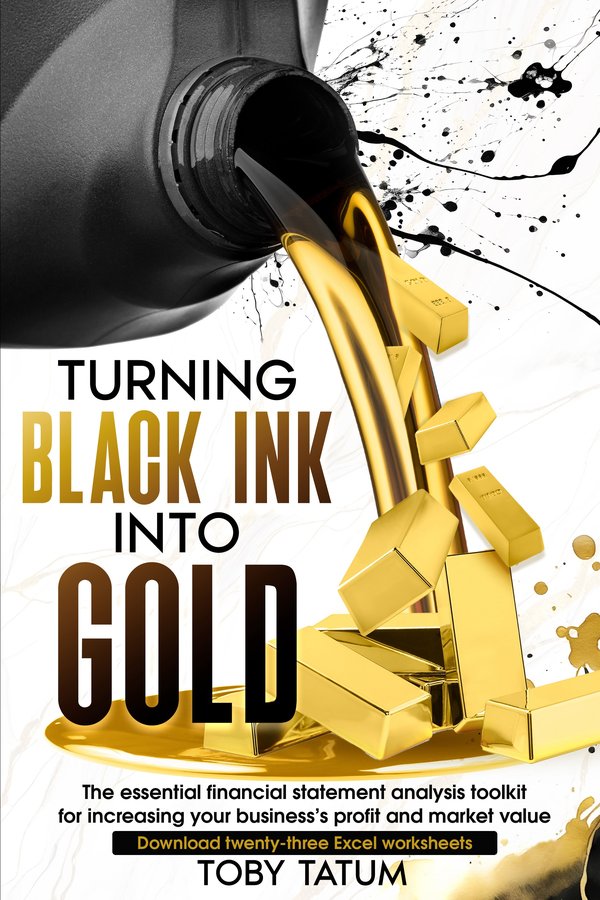
The judge's reasoning
Tatum's argument is stated plainly and then earns its keep: a small-business P&L built for the tax return is useless for managing the business or selling it, and the fix is mostly reorganization, not new bookkeeping. The book is unusually specific about what to do. The eight-category P&L, with Discretionary Cash Flow from Operations replacing Net Profit as the "quintessential bottom line," is a real structural idea. The warning that adding owner draws on top of discretionary cash flow is a double-counting error is the kind of detail only a person who has looked at over a thousand statements would think to include.
The evidence is anchored in cases rather than assertion. The firewood seller who "just knew" his cost of goods was 60% while his cash-basis books showed it swinging from 0% to over 100% makes the case for accrual accounting better than any definition could. The auto repair owner taking 16% of sales against an industry norm of 8%, with a bookkeeper who never said a word, shows what a missing red-flag report costs.
Best of all is the labor-productivity equation from Tatum's Sizzler years. Average wage divided by revenue per customer, divided by labor cost as a percent of sales, gives customers served per labor hour. It solved a real mystery, a senior-heavy location with a seemingly bloated labor percentage, and was worth about $75,000 a year. That is a takeaway a reader can use on Monday.
The cautionary tale of the owner who "was much too clever to get caught" has a dry, principled voice and a clear moral. This is a practical toolkit from someone who ran the restaurants, brokered the sales, and valued the businesses.

Judged by Arthur Beaumont — Non-Fiction · Memoir · Business · Self-Help
"A good non-fiction book changes one specific thing about your week."
Supporting passages
"The primary objective of the P&L should be to report the company's cash flow."
A clear, contrarian thesis that reframes the whole book and is then supported with a concrete, workable P&L structure.
"Divide the average hourly wage for the month or week by the average revenue per customer, then divide that result by labor cost's percentage of sales revenue."
A usable formula from the author's own restaurant operations, worked through with real numbers and a real cost saving.
"This approach is known as management by exception via statistical process control analysis."
Borrowing CNC machining tolerances to set an allowable variance for cost-of-goods-sold percentages is a fresh, practical way for owners to decide what deserves attention.
Per-axis rubric scores
Every Booky-winning book is scored across all ten craft axes. The award category comes from the top axis; a second axis at or above 75 appears as secondary recognition.
Find out what your book does best.
Submit your book today. Get a real, honest, category-specific Booky — or every dollar back.
Submit Your Book → Screen Another Book