
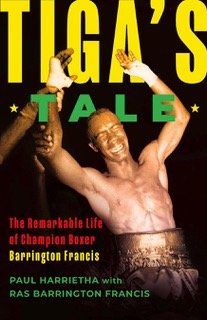
Tiga's Tale: The Remarkable Life Of Champion Boxer Barrington Francis
by Paul Harrietha
MOST UNSETTLING ATMOSPHERE BOOKY
Takes you to this book's Amazon page.
The judge's reasoning
The strongest thing Tiga's Tale does is put you inside Trench Town without ever making the poverty performative. Harrietha and Francis don't just tell you the yard was poor — they give you the cast-concrete walls built to "contain" slaves centuries earlier, the outhouses with "mismatched doors, wonky hinges," the jackass-rope smoke burned to mask the latrine stench, the standpipe queues that meant the difference "between civility and survival." The detail about slave-era law requiring seven-foot walls around any four huts, tied directly to the tenement yard Barrington grew up in, is the kind of historical grounding that turns memoir into argument — this isn't ambient scene-setting, it's a thesis about how colonial structures persist in concrete form.
The structural choice to intercut the framed 1998 title fight (rendered almost like ringside commentary — "a merry-go-round as it gains momentum") with the chronological Jamaica narrative gives the book a spine that a straight birth-to-belt biography would lack. Round 1 and Round 2 aren't just scene-setting gimmicks; they're doing thematic work, letting the reader feel Tiga's defensive, patient fighting style before the book explains where that temperament was forged — in a childhood that taught him, quite literally, to watch violence from a wall rather than wade into it.
The Uncle Tissi reveal — casual disciplinarian revealed as Commonwealth champion Percy Hayles — lands with real narrative craft, and the passport/portrait-studio sequence, withheld from the boys until dinner, is genuinely moving without straining for pathos. The prose occasionally over-explains (the sociology-textbook asides on Jamaican politics run long), but the lived texture of the ghetto is precise, specific, and earned.

Judged by Arthur Beaumont — Non-Fiction · Memoir · Business · Self-Help
"A good non-fiction book changes one specific thing about your week."
Supporting passages
"It is generally understood in the ghetto that under the laws of the time, any piece of land with four or more slave huts on it had to be enclosed by a wall at least seven feet high and to offer only one means of entry."
This historical detail, tied directly to the tenement yard the family lives in, gives the setting genuine argumentative weight rather than mere atmosphere.
"At the sound of the bell, Modest and Tiga stride purposefully to the centre of the four hundred square- foot ring — part sanctuary, part prison cell — that will serve as their battleground for the next thirty- six minutes."
The intercut fight-night frame gives the memoir a structural spine, letting the reader feel Tiga's temperament before the backstory explains it.
"She convulsed in tears, rose quickly with her head in her hands, and sprinted away from the gathering."
The withheld-news device around the passport photos lands the departure from Jamaica with restraint rather than melodrama.
Per-axis rubric scores
Every Booky-winning book is scored across all ten craft axes. The award category comes from the top axis; a second axis at or above 75 appears as secondary recognition.
Find out what your book does best.
Submit your book today. Get a real, honest, category-specific Booky — or every dollar back.
Submit Your Book → Screen Another Book