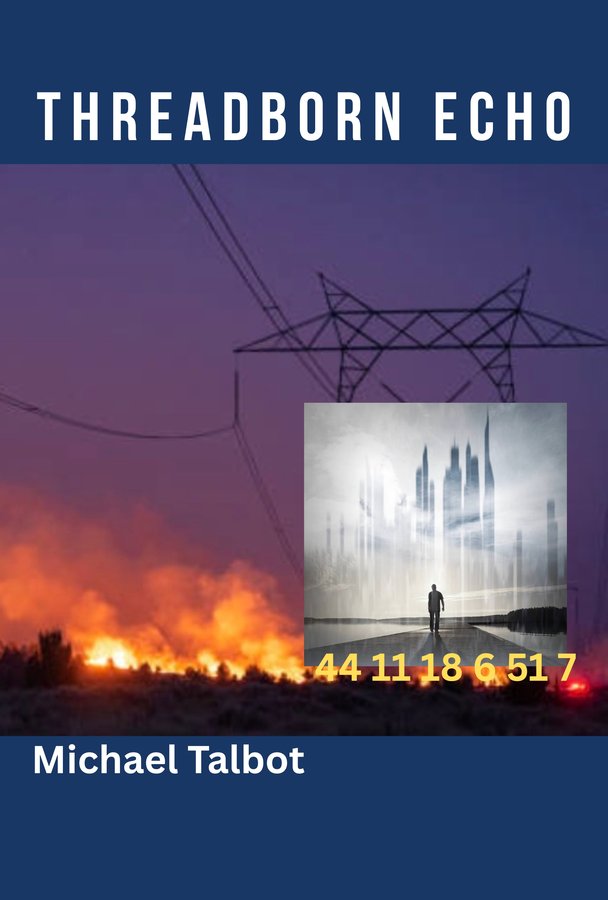
Threadborn Echo
by Michael Talbot
MOST BOOKTOK-READY BOOKY
Takes you to this book's Amazon page.
The judge's reasoning
Talbot has built a hook that works on two clocks at once. The prologue's slow-motion grid collapse — "Amber meant observe. Amber meant the grid was still holding" — is doing quiet, patient work: it's not describing a wildfire so much as describing systems failing to communicate, which is exactly the anxiety the domestic chapters replay in miniature when Dan can't get a straight signal from Eric. That's a smart structural bet — pairing a disaster-report register with sitcom-warm suburbia — and it pays off in the dinner-table scene where Harper grabs the whiteboard and declares, only half-joking, "We can sell it to Hollywood and buy me a new car," while Dan is genuinely rattled by a coworker who told him, with real fear, to never write an idea down. The premise (send-the-numbers-back time travel, refracted through a data analyst's boredom rather than a physicist's lab) is familiar territory dressed in a fresh, workaday coat, and Eric's line — "Promise me, Dan" — lands as a good chapter-turn.
The family gives the hook somewhere to live. Laura's dry "That's why he's Eric and I'm me," Harper's motor-mouth theorizing, Shaun's deadpan "So, he actually said don't write it down… That's weird, even for a government data geek" — these aren't interchangeable voices, and the detail of Oreo the cat tolerating Eric "better than most people did" is the kind of specific, affectionate observation that makes a minor character land in one sentence. The award here is for the premise's pull and the household's believability, not for sentence-level polish, which still needs tightening.

Judged by Eleanor "Nell" Whitcombe — Literary Fiction · Prose & Style
"A sentence either earns its breath or it doesn’t."
Supporting passages
"This was not a story about a broken transformer. It was a story about timing. About coordination under pressure. About what happens when complexity outpaces control."
A prologue line that reframes the disaster as a thematic key for the whole book, giving the hook intellectual weight beyond spectacle.
"His only constant companion was a black-and-white cat named Oreo, who, Dan suspected, tolerated Eric better than most people did."
A small, specific, funny detail that does more character work than a paragraph of description.
Per-axis rubric scores
Every Booky-winning book is scored across all ten craft axes. The award category comes from the top axis; a second axis at or above 75 appears as secondary recognition.
Find out what your book does best.
Submit your book today. Get a real, honest, category-specific Booky — or every dollar back.
Submit Your Book → Screen Another Book