
They Were in Prison and I Visited Them
by Terry L. Olson
MOST ACHING READ BOOKY
Takes you to this book's Amazon page.
The judge's reasoning
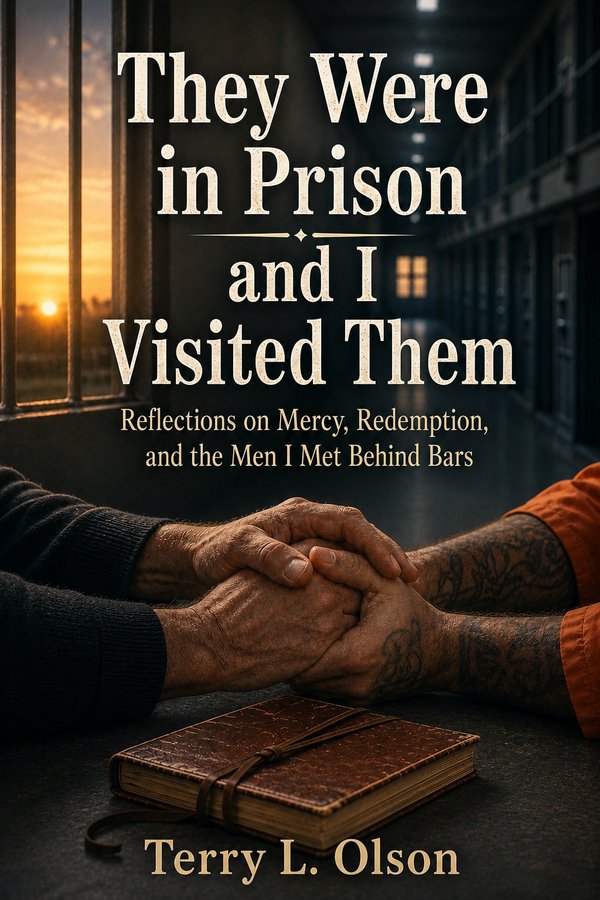
They Were in Prison and I Visited Them earns its place on the strength of raw, unguarded emotional honesty that is genuinely difficult to manufacture — and Terry Olson doesn't manufacture it. The autobiographical first section moves through decades of accumulation and loss — the IRS bondage, the hotel-room closet breakdown at Disneyland, the brain-stem surgery, the daughter's school report naming her broken father as her hero — and each of these moments lands because Olson refuses to clean them up. When eleven-year-old Katie says "You are the strongest man I have ever seen" to a man who just called himself "a slug," the reader feels the reversal in the chest, not the head. That's earned resonance.
The thematic argument — that mercy is not sentiment but structural necessity, that no marriage, no justice system, no human relationship survives without it — is stated plainly and then demonstrated through the prison vignettes: the man weeping over a blackberry after twenty-five years, two men of opposing gangs standing up and crossing a table to embrace after opening letters from strangers. Olson does not editorialize these moments to death; he lets them sit. The endorsements from Doug Gallagher and Amy Mann function as testimonial evidence for the book's central claim, and they work: Gallagher's letter in particular is its own small document of transformation.
The prose is uneven — repetitions creep in, sentences occasionally trip over themselves — but the voice is unmistakably one man's, shaped by suffering and scripture in equal measure. For its intended readership in Christian ministry and prison-reform circles, that authenticity is the book's primary credential.

Judged by Eleanor "Nell" Whitcombe — Literary Fiction · Prose & Style
"A sentence either earns its breath or it doesn’t."
Supporting passages
"She says, Dad today they asked us to write a report in school about a Hero of ours and I picked you. I said in utter astonishment; "me, why me, I am but a slug!" She replied: dad, for years you have been suffering now. You have never stopped trying to be kind. You have never stopped fighting for life."
The collision of Olson's self-described worthlessness with his daughter's unanswerable counter-testimony produces the book's most affecting single beat — grief and grace arriving simultaneously.
"In one weekend, as we were enjoying our home cooked meals, I looked across the table and saw a big man holding up a blackberry and tears were coming out of his eyes. Men learn early not to cry in prison because they will be preyed upon in so doing. I asked him if he was okay and he said: "I haven't had a blackberry in 25 years.""
This vignette does more argumentative work for the book's mercy thesis than a page of theology could — a single piece of fruit becomes an entire theory of deprivation and human dignity.
"Half the men I met in this maximum-security prison had not had a letter, a phone call, or a visit in over five years. So, when some 70 men show up with home-made food, cookies galore for both inmates and guards, accompanied by kind letters of encouragement, with some sleeping on wood floors for the privilege, the four days can become the seed of some serious life changing, as mercy lets everyone start anew."
Olson delivers the practical mechanics of Kairos ministry with the specificity that readers in Christian ministry contexts need — concrete, replicable, and grounded in observed human behavior rather than abstraction.
Per-axis rubric scores
Every Booky-winning book is scored across all ten craft axes. The award category comes from the top axis; a second axis at or above 75 appears as secondary recognition.
Find out what your book does best.
Submit your book today. Get a real, honest, category-specific Booky — or every dollar back.
Submit Your Book → Screen Another Book