
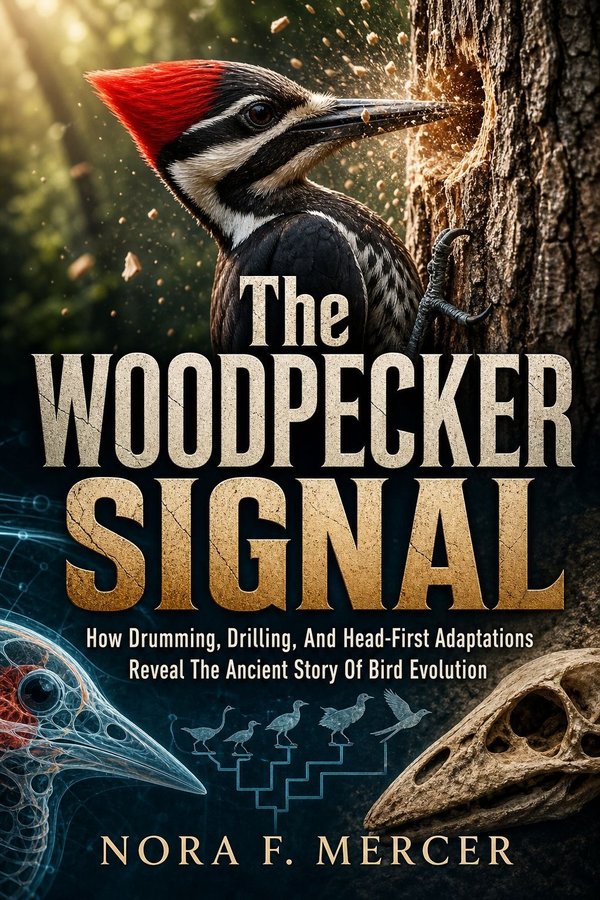
The Woodpecker Signal
by Nora F. Mercer
BOLDEST BIG IDEA BOOKY
Takes you to this book's Amazon page.
The judge's reasoning
Mercer's real achievement is the framework she keeps returning to across all three opening chapters: the distinction between local adaptation — the bill shape tuned to a particular beetle, the drumming rhythm tuned to a particular forest's acoustics — and deep evolutionary inheritance, the older vertebrate architecture that made any of that fine-tuning possible in the first place. This isn't a throwaway distinction; it's the spine of the book, restated with variation at the level of drumming, of foraging, of cavity excavation, of skull mechanics, so that by the time the reader reaches the hyoid apparatus wrapping around the skull, the conceptual scaffolding feels earned rather than imposed. The line 'Local adaptation explains why one species may thrive in one kind of forest and not another. Deep inheritance explains why the family as a whole can do what it does at all' is the kind of sentence a popular-science book lives or dies by — it converts a technical distinction into something a general reader can hold onto and reapply chapter after chapter.
The book also does the harder, less flashy work of refusing to let 'pecking' collapse into a single behavior. Separating drumming (message), foraging (search), and excavation (construction) as three distinct mechanical and evolutionary problems that happen to share a bill is a genuinely useful piece of science communication, and it's sustained rigorously rather than gestured at once and abandoned. That discipline — three chapters in, still asking 'what does this motion actually cost, and to what end?' — is what earns this book its recognition.

Judged by Eleanor "Nell" Whitcombe — Literary Fiction · Prose & Style
"A sentence either earns its breath or it doesn’t."
Supporting passages
"Local adaptation explains why one species may thrive in one kind of forest and not another. Deep inheritance explains why the family as a whole can do what it does at all."
The book's organizing distinction, stated with the clarity of a thesis sentence rather than a stray observation.
"A cavity is not just a hole in a tree. For a woodpecker, it is architecture, insulation, refuge, and inheritance all at once."
A clean, quotable expository move that does the genre's core job — reframing a familiar object as a more complex system — without overreaching into false lyricism.
"The trunk is where that history becomes visible."
A short declarative close that earns its brevity after a paragraph of accumulation — one of the book's few moments of real sentence-level restraint.
Per-axis rubric scores
Every Booky-winning book is scored across all ten craft axes. The award category comes from the top axis; a second axis at or above 75 appears as secondary recognition.
Find out what your book does best.
Submit your book today. Get a real, honest, category-specific Booky — or every dollar back.
Submit Your Book → Screen Another Book