
The Wisdom of the Axolotl
by Claudia Jones
BEST SERIES POTENTIAL BOOKY
Retailer link provided by the author.
The judge's reasoning
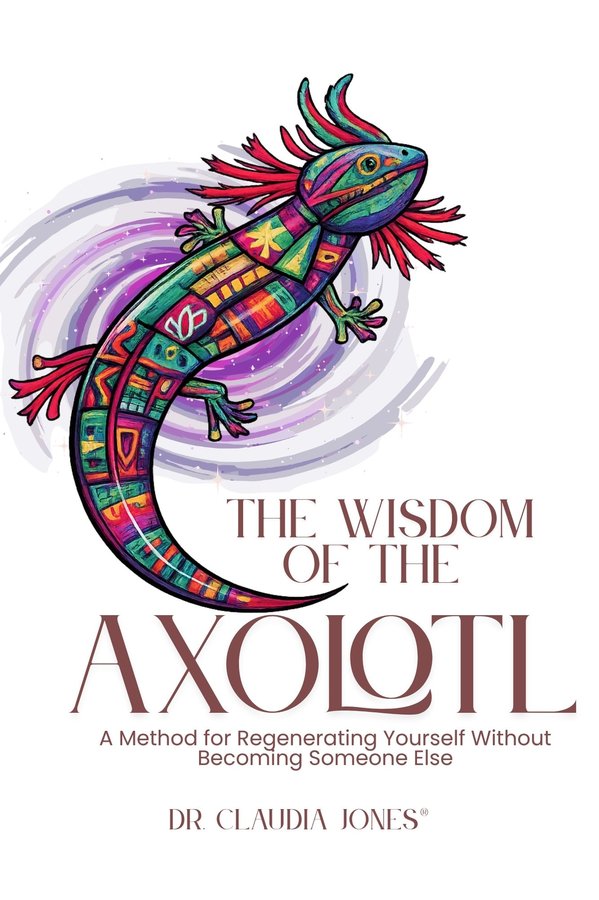
Claudia Jones has found a hook that does real work. The axolotl is not decoration. It is the book's engine. The central contrast, set up in the Threshold and paid off in Chapter 1, is that a thyroxine-induced metamorphosis makes the axolotl "lose its gills, its skin thickens," and it can no longer regenerate. "From the outside, it appears to be evolution. From the inside, it is a loss." That image gives the reader a way to separate chosen transformation from forced metamorphosis. It is the best idea in the book, and it is portable. A reader can carry it into a bad job, a stalled migration, or a role that has stopped fitting, and ask which kind of change they are living through.
The acronym A-X-O-L-O-T-L is the kind of device that sells a book and survives on a bookshelf, but here it also sorts the argument into a usable order: authenticity, then justice to your story, origin, limits, onus, transformation, essence. The chapters repeat one shape (definition, human example, axolotl parallel, "What You Gain," exercise), so the reader always knows what to expect. The exercises are short and honest. They end with a distinction rather than a pep talk: "Naming the incoherence won't break you. Living in sustained incoherence will."
Two features separate this from the generic coherence-and-boundaries shelf. The Methodological Note and Chapter 9 say plainly that humans do not regenerate like axolotls and that the analogy is symbolic, not literal. And the Xólotl myth is read as refusing annihilation rather than refusing change, which suits readers who have migrated, adapted, and quietly lost something. That audience is the book's real reader.

Judged by Arthur Beaumont — Non-Fiction · Memoir · Business · Self-Help
"A good non-fiction book changes one specific thing about your week."
Supporting passages
"The transformed axolotl loses its ability to regenerate. The cellular pathways responsible for repair shut down. The organism survives, but it can no longer rebuild itself."
A single concrete biological fact becomes the book's test for telling real transformation from forced adaptation, and readers can apply it to their own lives.
"Understanding without deciding is a subtle way of continuing to wait."
The Onus chapter names a familiar trap, understanding as refuge, and turns it into a pointed prompt for action.
"He did not resist change. He refused to disappear to satisfy expectation."
Reading the Xólotl myth as a refusal of self-erasure rather than of change gives familiar self-help ideas a fresh and culturally grounded anchor.
Per-axis rubric scores
Every Booky-winning book is scored across all ten craft axes. The award category comes from the top axis; a second axis at or above 75 appears as secondary recognition.
Find out what your book does best.
Submit your book today. Get a real, honest, category-specific Booky — or every dollar back.
Submit Your Book → Screen Another Book