
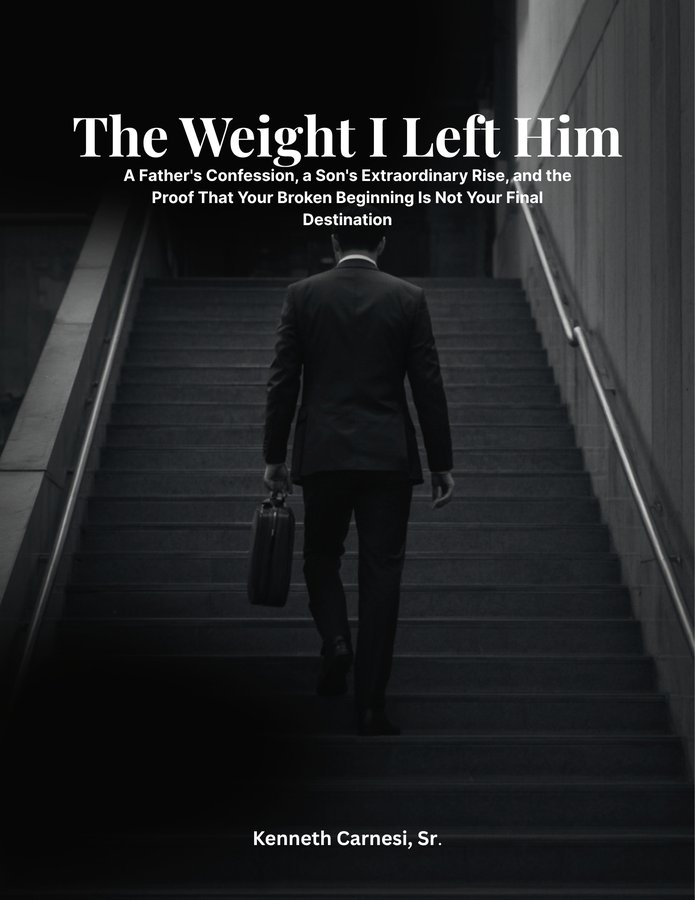
The Weight I Left Him
by Kenneth Carnesi, Sr.
BEST TREATMENT OF FORGIVENESS BOOKY
The judge's reasoning
Carnesi's book earns its keep on the strength of a single, well-executed structural decision: it makes the father's confession the load-bearing wall of the argument, not a preamble to be skimmed past on the way to the son's success story. "This book starts with a confession because without it, nothing that follows means anything" is stated outright, and the book actually honors that promise — Chapter 1 doesn't summarize failure, it itemizes it ("over seven years," "absent in attention," "confused the wanting with the doing"). That specificity is the book's real achievement; it refuses the soft self-serving admission it explicitly names and rejects.
The theme — that a broken starting point produces real, usable capacities rather than just damage — is argued, not just asserted. Chapter 3's four named instincts (reading a room, functioning under pressure, resourcefulness, refusing to wait) work as a genuine taxonomy readers can check their own lives against, and the "Putting It Into Practice" sections turn each chapter's claim into an actual writing exercise rather than a platitude. The "hypothetical Daniel/Eli" composites are a smart hedge — they let the author generalize the son's psychology to the reader without over-claiming access to someone else's interior life, which is the book's chief structural risk given it's a father narrating a son's story.
Where it wobbles: the prose leans hard on repetition-as-emphasis ("Real ones... Actual ones... Actually do them") to the point of padding, and the son himself remains more symbol than person — we get his effects, rarely his voice. But the moment at the kitchen table where the father watches his adult son handle a crisis alone and understands, for the first time, the price tag on that competence — that's a real scene, earned honestly, and it's the emotional hinge the whole book turns on.

Judged by Arthur Beaumont — Non-Fiction · Memoir · Business · Self-Help
"A good non-fiction book changes one specific thing about your week."
Supporting passages
"He wasn't self-sufficient because he'd been given every opportunity to grow. He was self-sufficient because I'd left him no other choice."
This is the book's clearest articulation of its central argument — capability and cost as the same coin — stated without softening.
"I stood there watching him and understood, with a clarity I hadn't let myself feel before, that his capability had come at a price I'd charged him without his consent."
The moment of recognition is specific and unflinching rather than sentimental, which is what makes it land.
"Write them down. You can't start separating yourself from something you haven't clearly identified yet."
The chapter-end exercises convert abstract reflection into concrete practice, which is the genre's core promise.
Per-axis rubric scores
Every Booky-winning book is scored across all ten craft axes. The award category comes from the top axis; a second axis at or above 75 appears as secondary recognition.
Find out what your book does best.
Submit your book today. Get a real, honest, category-specific Booky — or every dollar back.
Submit Your Book → Screen Another Book