
The Triumph of the Lamb: Revelation and Its Parallels
by Keith J. Miller
BEST TREATMENT OF BELONGING BOOKY
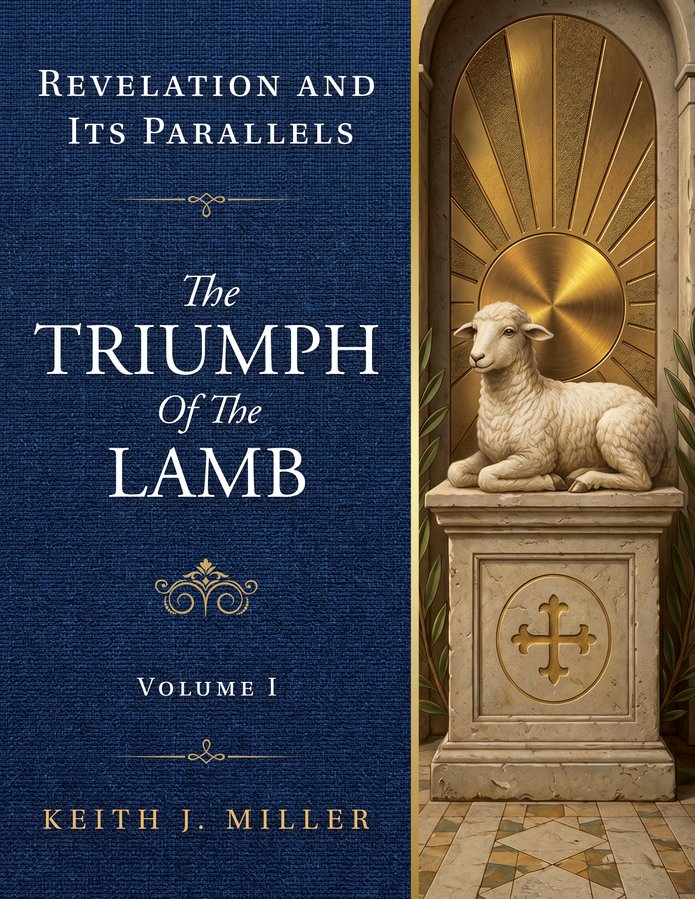
The judge's reasoning
Miller's book earns its place in a crowded field of Revelation commentaries by doing something narrower and more disciplined than most: it refuses the temptation to decode, predict, or terrify, and instead builds its entire argument on cross-referencing Scripture with Scripture. The numerological survey — three, four, seven, ten, twelve, twenty-four, the 3½-year cycles — is not filler; it is patiently built, verse by verse, from Genesis through the Gospels into Revelation, and each number is treated as a "theological signpost" rather than a cipher to crack. That's a genuinely useful hermeneutical move for the lay reader this book is written for, and it's executed with real consistency rather than cherry-picked prooftexting.
The autobiographical introduction is the book's emotional spine, and it's the strongest writing here: the CT scan with "seven areas of calcified plaque," the cardiologist's flat "there's nothing there," the tearstained Disciple's Study Bible from 1992. These are concrete, lived details that do the work abstraction can't, and they justify the pastoral urgency behind the project — this is a man who avoided 60 percent of a book of the Bible out of fear, and says so plainly.
Where the book is strongest as a category entry is its even-handed treatment of the four major interpretive schools (futurist, preterist, historicist, idealist), refusing to adjudicate a winner and instead showing each view's genuine textual footing and honest limitation — a rare discipline in this genre. For readers wanting a scripture-first, non-sensationalized way into Revelation, that's the real gold, exactly as one blurb notes.

Judged by Eleanor "Nell" Whitcombe — Literary Fiction · Prose & Style
"A sentence either earns its breath or it doesn’t."
Supporting passages
"The book of Revelation cannot mean for us today what it did not mean for the first-century churches to whom it was originally addressed."
A clear, disciplined hermeneutical anchor that organizes the whole project and distinguishes it from speculative end-times reading.
"Rather than competing explanations to be chosen or discarded, these approaches often overlap and inform one another."
The book's fair-minded survey of interpretive schools is exactly what a study guide in this genre should do rather than push a single agenda.
"Everything that had shown up on my earlier scan was gone. When I pressed him for clarification, he explained, "There is no plaque at all. Honestly, it's as if you have brand new arteries.""
A concrete, specific personal turn that grounds the book's abstract theology in lived stakes.
Per-axis rubric scores
Every Booky-winning book is scored across all ten craft axes. The award category comes from the top axis; a second axis at or above 75 appears as secondary recognition.
Find out what your book does best.
Submit your book today. Get a real, honest, category-specific Booky — or every dollar back.
Submit Your Book → Screen Another Book