
The Ten-Year Silence
by Skyler Avalon
TENSEST THRILLER BOOKY
Takes you to this book's Amazon page.
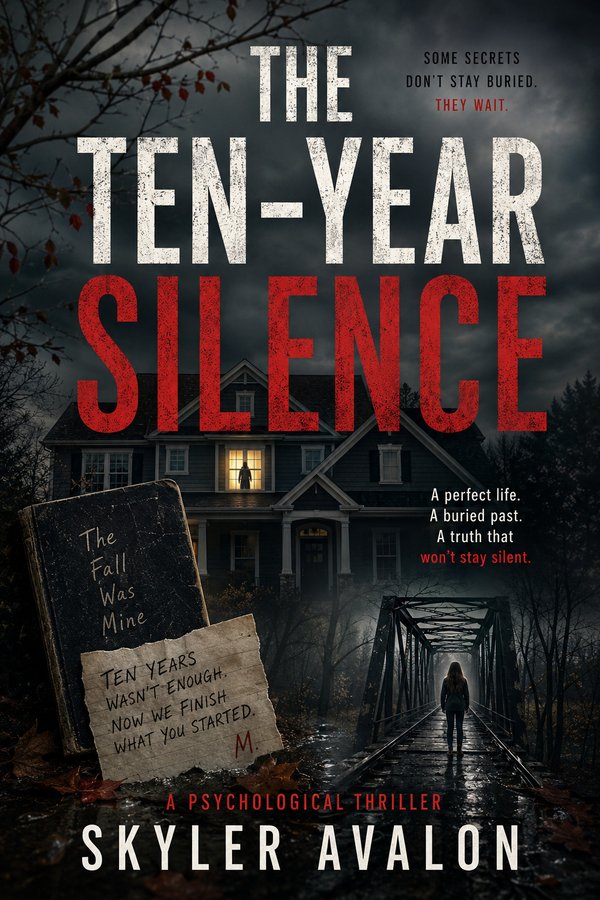
The judge's reasoning
This is a book that knows the machinery of the domestic-suspense thriller and runs it with confidence. Avalon opens on the classic double-life setup — Melinda's 'curated silence' kitchen theater versus the Prufrock paperback that shouldn't exist in her house — and by the end of Chapter 1 has planted three separate threads (the book, the tower memory, the sedan with the lens) without letting any of them collapse into exposition dump. That's disciplined plotting.
The chapter-to-chapter handoff is the real strength. Each chapter ends on a hook that reframes the previous one: the wind chime note with the Prufrock line lands right as we've just watched Melinda burn an identical stanza, and Liam's discovery that he personally buried Karen's prowler complaint turns him from investigator into culprit-adjacent in one paragraph. The structural irony of 'Karen hadn't been gossiping. She'd been watching the watcher' is a clean, earned turn — it reframes the missing-neighbor plot as surveillance-of-the-surveilled, which is a nice thriller-brain move.
The multi-POV rotation (Melinda, Liam, Riley) is used correctly for the genre: each character knows a different fragment of the ten-year-old secret, and the reader is assembled into dramatic irony faster than any one character. Riley's library encounter with the man muttering 'the shadow is the substance' — a phrase that then surfaces in her mother's decade-old letters — is the book's best-executed convergence, tying three characters' arcs together through a single found phrase. That's plot discipline that pays off, and it's what earns this book its recognition.

Judged by Marcus Thorne — Thriller · Mystery · Suspense · Commercial Fiction
"Plot is promises kept."
Supporting passages
"Karen hadn't been gossiping. She'd been watching the watcher."
A clean genre reversal that recontextualizes the missing-persons plot as surveillance of the protagonists themselves.
"The shadow is the substance, little Bennett. You should tell your mother that. Tell her the archives never truly close."
Plants a phrase that resurfaces in Melinda's decade-old letters, threading three POV characters into one mystery.
"It looks fine, Mom. Everything always looks fine."
Riley's flat teenage indictment cuts through Melinda's performative domesticity in one economical line.
Per-axis rubric scores
Every Booky-winning book is scored across all ten craft axes. The award category comes from the top axis; a second axis at or above 75 appears as secondary recognition.
Find out what your book does best.
Submit your book today. Get a real, honest, category-specific Booky — or every dollar back.
Submit Your Book → Screen Another Book