BookyAwards · 2026
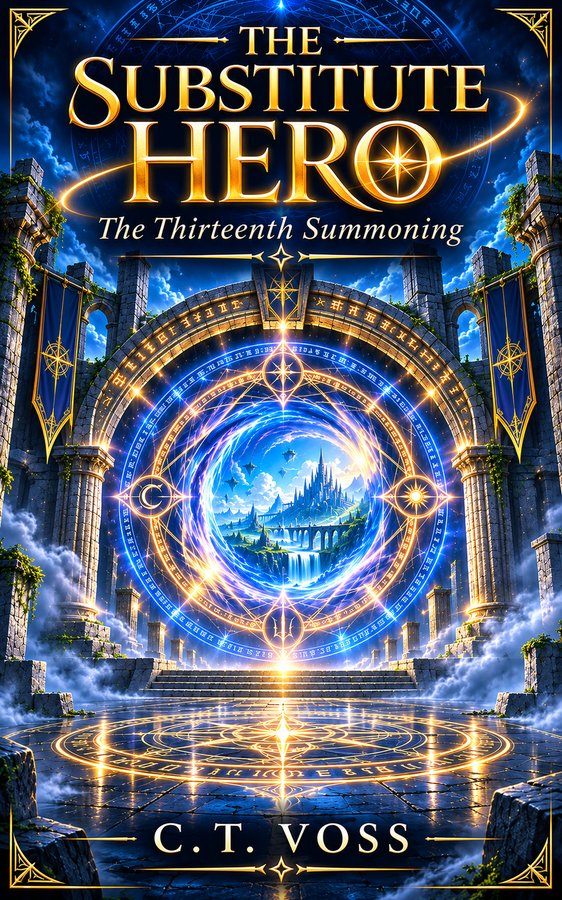
The Substitute Hero: The Thirteenth Summoning
by Chris Todd Andaya
Most Thought-Provoking Booky
Retailer link provided by the author.
The citation
The judge's reasoning
The Substitute Hero takes the isekai summoning-of-champions story and asks a question the genre usually skips: what does a teacher actually do when twelve children are handed godlike powers? The answer, carried through all twenty-eight chapters, is that power is not the point; the discipline of using it is.
The novel's thematic spine is stopping. Maya's Dawnblade can cut through a courtyard wall, and her arc isn't about wielding it more spectacularly. It's about learning that "shape, distance, stop" are three separate decisions, and that releasing a blade cleanly is a skill worth drilling. Caleb's fire lesson ('You stopped producing fire. You did not put it out') and Nora's refusal to heal everything her affinity can see make the same argument from different angles. The Harrowgate climax honors this: the rescue succeeds because of a ledger, a roster, a recorded conversation, and Lysa's insistence that "presumed clear" is not an inspection. The bureaucratic horror is sharp. A refuge of forty-six people vanishes because a registry counts tokens rather than humans.
Elias's secret is the book's strongest dramatic engine. His affinity lets him absorb competence by teaching it, which makes every good lesson ethically fraught. His concealment is a real moral failing, and Maya's quiet question ('Did you ever make us repeat something because you wanted the power?') lands because the book has earned it. His closing act of writing his own name on the attendance sheet is a small, exact payoff to a premise planted in Chapter One.
This is a humane, thoughtful book that treats teaching as heroism and institutional carelessness as its true antagonist.
From the book
Supporting passages
""You stopped producing fire. You did not put it out.""
""The receiver records tokens," Lysa replied, without looking up. "It records them very well. That is not the same service as counting people.""
"Below the final student's name, on a line that had never existed in the original roster, he wrote his own."
The scorecard
Per-axis rubric scores
Every Booky-winning book is scored across all ten craft axes. The award category comes from the top axis; a second axis at or above 75 appears as secondary recognition.
- Prose & Style 77
- Characterization 82
- Dialogue 78
- Plot & Structure 80
- World-Building 79
- Originality SECONDARY RECOGNITION 84
- Emotional Resonance 80
- Theme & Substance AWARDED 87
- Genre Execution 80
- Marketability & Hook 80
Scores out of 100
Find out what your book does best.
Submit your book today. Get a real, honest, category-specific Booky — or every dollar back.
