
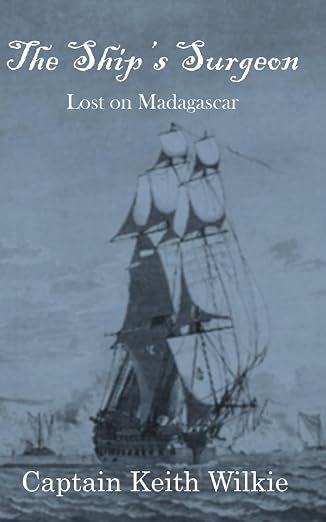
The Ship's Surgeon: Lost on Madagascar
by Capt Keith Wilkie
BEST TREATMENT OF LOVE BOOKY
The judge's reasoning
The Ship's Surgeon earns its place on the strength of what it chooses to carry. Wilkie takes a real Edinburgh tailor's son, a documented ship, a doomed Scottish company and a trial that hanged men, and builds a novel that holds historical record and imagination apart honestly. The closing Afterword, which sets the Drury journal, the Phipeny affidavit and the two conflicting reports of the Maritan seizure side by side and declines to settle them, is the kind of scruple most historical fiction never attempts.
The book's moral weight is its best achievement. The central device is the tailor's rule, "A seam either holds or it doesn't," which John Wilkie hands his son at the bench and which comes back at the worst possible moments. It returns in the stockade at Saint Mary's, where Andrew sews a captive's forearm and his hand shakes for the first time in his life. The scene where Captain Drummond informs him the ship will carry human cargo to Bourbon, and Andrew realizes that every wound he closes will raise the French price, gives the novel its conscience without any speechifying. It is a surgeon's complicity, rendered through hands rather than argument.
Emotionally, the book is at its best in small, concrete beats: Andrew sewing in the dark on the stair while his mother labors above, the needle case passed from father to son, Isabel standing at the edge of the Sands of Leith turning her needle case over "the way she might have held a child's hand." The structure's late turn to James and the trial is risky and largely pays off, because it converts a missing-person story into an indictment of how a country hunts for someone to blame. The ending, which leaves Andrew on the beach at Maritan, is truthful to the record and genuinely moving for refusing a false resolution.

Judged by Eleanor "Nell" Whitcombe — Literary Fiction · Prose & Style
"A sentence either earns its breath or it doesn’t."
Supporting passages
""A seam either holds or it doesn't," John said quietly. "You know that. Make yours hold.""
The tailor's craft ethic becomes the moral spine of the book, carried across an ocean and tested against the slave trade.
"He sewed until his fingers were numb with the cold. He sewed until the stair above him went quiet, so quiet that he stopped with the needle halfway through the cloth and could not breathe."
A child's helplessness is expressed through his hands, planting the image the novel later pays off at sea.
"He did not look like a monster. He looked like a man who had not slept."
James's first sight of Captain Green quietly complicates the town's appetite for a villain and deepens his own guilt.
Per-axis rubric scores
Every Booky-winning book is scored across all ten craft axes. The award category comes from the top axis; a second axis at or above 75 appears as secondary recognition.
Find out what your book does best.
Submit your book today. Get a real, honest, category-specific Booky — or every dollar back.
Submit Your Book → Screen Another Book