
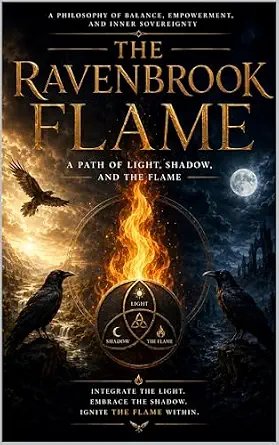
The Ravenbrook Flame
by Richard Ravenbrook
MOST UPLIFTING READ BOOKY
The judge's reasoning
The Ravenbrook Flame is doing something that a surprising number of self-help books fail at: it meets its reader in the actual feeling of spiritual exhaustion before it tries to sell them a solution. The Seeker-Architect dialogue format earns its keep here. When the Architect says, "The exhaustion isn't just a physical weariness; it was a bone-deep depletion, a soul-level fatigue born of a constant, exhausting tug-of-war," it isn't offering a diagnosis — it's offering recognition, and for the reader who bought this book, that recognition is the point of entry.
The central thesis — that Light and Shadow are not adversaries but complementary forces requiring conscious integration, with the Flame as the active awareness that holds both — is coherent and consistently pursued across these opening chapters. This is a real argument, not a cluster of vibes. The volcano metaphor (suppressed Shadow building until catastrophic eruption) and the sun/dark earth image (Light provides vision, Shadow provides the nutrient-rich ground from which growth springs) are the kind of concrete analogies that make abstract psychological and spiritual concepts stick for a general audience.
The Seeker-Architect structure also does legitimate characterization work: the Seeker's admission that spiritual failure felt like being "a bad spiritual person" rather than merely a struggling one is a precise emotional beat that readers in this genre will recognize viscerally. The book earns its emotional register in those moments of specificity. Where it occasionally loses ground is in prose that slides into repetitive cadence — the word "precisely" affirms the Seeker's insights so often it begins to feel mechanical — but the underlying warmth and sincerity of the philosophy carries through.
Judged by Arthur Beaumont — Non-Fiction · Memoir · Business · Self-Help
"A good non-fiction book changes one specific thing about your week."
Supporting passages
"It wasn't just that they felt bad; they felt like a bad spiritual person."
This single sentence does more emotional work than paragraphs of surrounding prose — it names the specific shame that distinguishes spiritual self-help readers from general self-help readers, and earns the book real credibility with its audience.
"Think of it this way: the Light offers the vision, the inspiration, the boundless potential for good. It's the sun, ever shining, ever life-giving. But the Shadow? The Shadow is the rich, dark earth. It holds the nutrients, the dense resilience, the unwavering foundation from which all growth springs."
The sun-and-soil analogy gives the Light/Shadow integration thesis its most grounded, memorable expression — concrete enough to be recalled and repeated by a reader, which is the practical test for self-help metaphor.
Per-axis rubric scores
Every Booky-winning book is scored across all ten craft axes. The award category comes from the top axis; a second axis at or above 75 appears as secondary recognition.
Find out what your book does best.
Submit your book today. Get a real, honest, category-specific Booky — or every dollar back.
Submit Your Book → Screen Another Book