
The Rational Mindset
by Critical Thinker Press
MOST SEARCHING MEMOIR BOOKY
Takes you to this book's Amazon page.
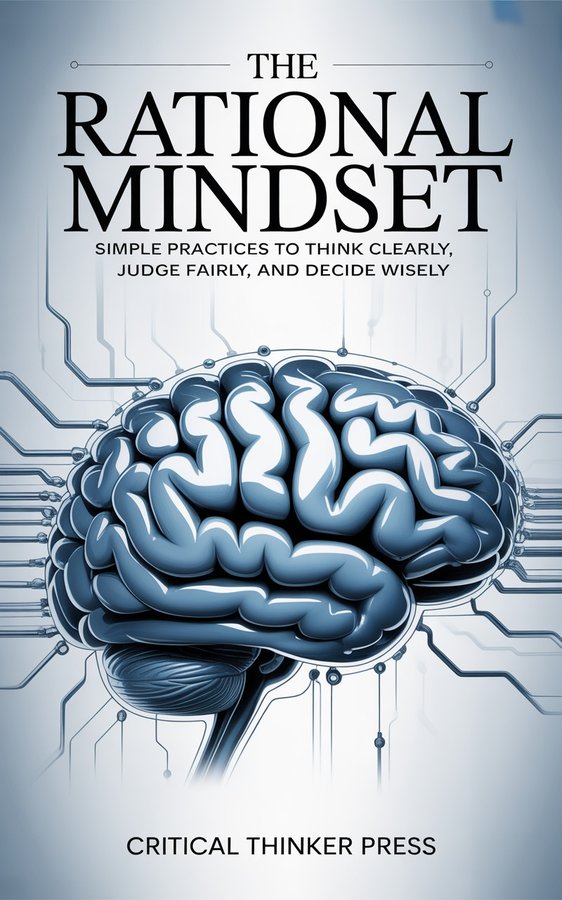
The judge's reasoning
The Rational Mindset does what the best practical-philosophy primers do: it takes a genuinely complex subject — the architecture of fair thought — and renders it navigable without condescending to the reader. Dr. Bennett's thematic range is real. The book doesn't content itself with cataloguing cognitive biases; it weaves together the epistemic (how we know what we know), the psychological (why we resist knowing it), and the ethical (what fairness actually demands of a decision-maker). The section on fairness in Chapter 3 is particularly grounded — the insistence that fairness requires attending to power dynamics, not merely applying consistent rules, is the kind of substantive claim that distinguishes a practitioner's book from a Wikipedia summary. The treatment of the halo and horn effects as distortions of fairness rather than mere cognitive curiosities shows a deliberate thematic architecture. Genre execution is comparably strong: the chapter-and-sub-section structure gives readers clear entry and exit points, the escalating complexity from foundational logic through bias management to professional decision-making follows a coherent pedagogical arc, and the recurring invitation to self-interrogate — "What am I assuming here?" — keeps the material actionable. The prose is serviceable and occasionally fluent, though it leans on the self-help register's characteristic repetition; a sentence like "the rational mindset acts like a compass" earns its keep, while several surrounding paragraphs rephrase the same point without adding new light. Still, for its intended reader, the book delivers consistent, specific, practical value.

Judged by Eleanor "Nell" Whitcombe — Literary Fiction · Prose & Style
"A sentence either earns its breath or it doesn’t."
Supporting passages
"Effective fairness also calls for awareness of power dynamics. Decisions rarely occur on equal footing—differences in influence, authority, and resources can shape outcomes. A fair-minded decision maker recognizes these imbalances and consciously guards against letting them skew judgment. Protecting the interests of those less powerful or marginalized ensures fairness does not become a code word for reinforcing the status quo."
This passage elevates the book's treatment of fairness beyond rule-following into genuine ethical reasoning, distinguishing it from generic critical-thinking titles.
"One common trap is the tendency to assume that what has worked before will always work again. In both personal and professional settings, this forward-looking assumption can blind us to changing circumstances or alternative options. For example, a manager might assume that their team will respond the same way to an incentive plan simply because it succeeded in the past. Without questioning this, they risk overlooking shifts in motivation, market conditions, or team dynamics."
The concrete workplace scenario anchors an abstract principle in exactly the kind of immediately recognisable situation practical-philosophy readers come for.
Per-axis rubric scores
Every Booky-winning book is scored across all ten craft axes. The award category comes from the top axis; a second axis at or above 75 appears as secondary recognition.
Find out what your book does best.
Submit your book today. Get a real, honest, category-specific Booky — or every dollar back.
Submit Your Book → Screen Another Book