
The Quiet War at Work
by T.M. Arden
MOST PERSUASIVE CASE BOOKY
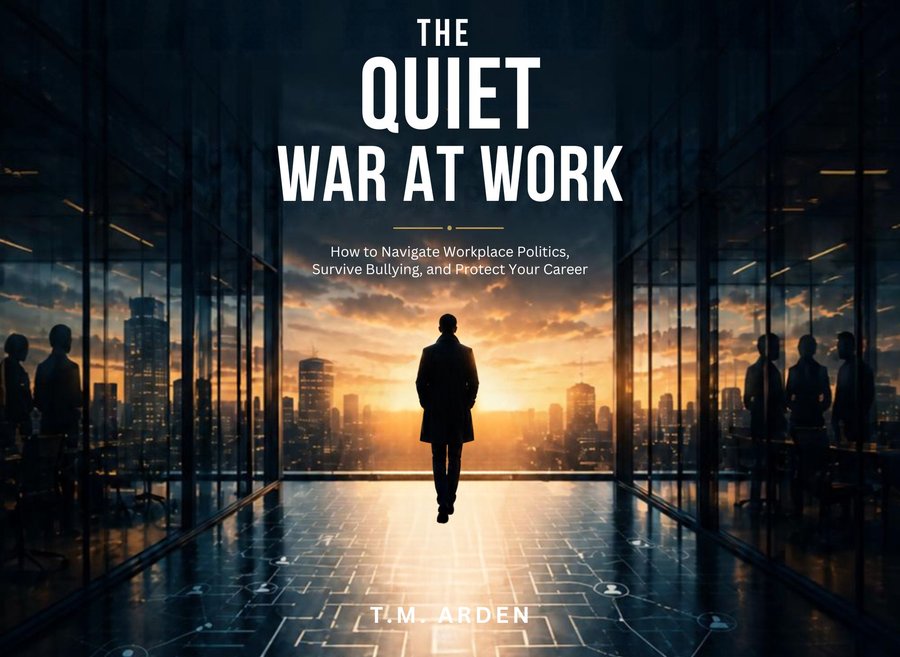
The judge's reasoning
Arden's real achievement here is refusing the easy binary that most workplace-bullying books settle for: villain versus victim. The three rules — Observe patterns. Verify facts. Protect options. — recur like a spine through every chapter, and they hold up because they're genuinely operational rather than motivational filler. The four-question test in Chapter 3 (repeated? power imbalance? selectively applied? interfering with work?) is the kind of thing a reader can actually hold up against their own Tuesday.
The book's sharpest move is structural: it escalates from individual cases (Jordan, Elena, Mei) to the $200 million ERP case study, which reframes bullying not as a personality defect but as a governance failure — Maya's redesigned dashboard, separating 'software defects from missing data, delayed business decisions, inadequate testing, and resistance to approved processes,' is a genuinely useful diagnostic template that could be lifted straight into a real workplace audit. That's rare in this genre, where most authors stop at 'document everything' and call it a day.
The composite cases (Jordan, Maya, Elena, Sofia) are thin as characters — they exist to illustrate, not to be known — which caps Characterization and Dialogue. But the argument structure compensates: each chapter's Reflection Questions and Action Plan aren't decorative, they're load-bearing, forcing the reader from diagnosis to next step. Line: 'Being targeted does not define your value... Keep your attention on the evidence, not the identity someone is trying to assign you.' That's the whole book in one sentence, and it earns its place.

Judged by Arthur Beaumont — Non-Fiction · Memoir · Business · Self-Help
"A good non-fiction book changes one specific thing about your week."
Supporting passages
"Observe patterns so one painful moment does not become your only evidence. Verify facts so fear, rumor, and assumption do not control the story. Protect options so your health, income, reputation, and future do not depend on a system behaving better than it has shown itself willing to behave."
The book's operating framework stated plainly and repeated with discipline, giving readers something to actually apply.
"Maya changed the reporting model. The dashboard now identified decision owners, required inputs, actual submission dates, aging exceptions, unresolved control risks, and the cost of parallel systems."
The extended ERP case study builds a full diagnostic escalation from individual grievance to organizational systems failure, a structural ambition beyond the typical listicle-style business book.
"The organization therefore taught everyone that expertise could purchase immunity. New employees stopped asking questions, experienced staff avoided collaboration, and managers became increasingly dependent on the person creating the risk."
A precise, lived account of how organizational dysfunction compounds and normalizes itself over time.
Per-axis rubric scores
Every Booky-winning book is scored across all ten craft axes. The award category comes from the top axis; a second axis at or above 75 appears as secondary recognition.
Find out what your book does best.
Submit your book today. Get a real, honest, category-specific Booky — or every dollar back.
Submit Your Book → Screen Another Book