
the operator annals
by ian hills
MOST BELIEVABLE FUTURE BOOKY
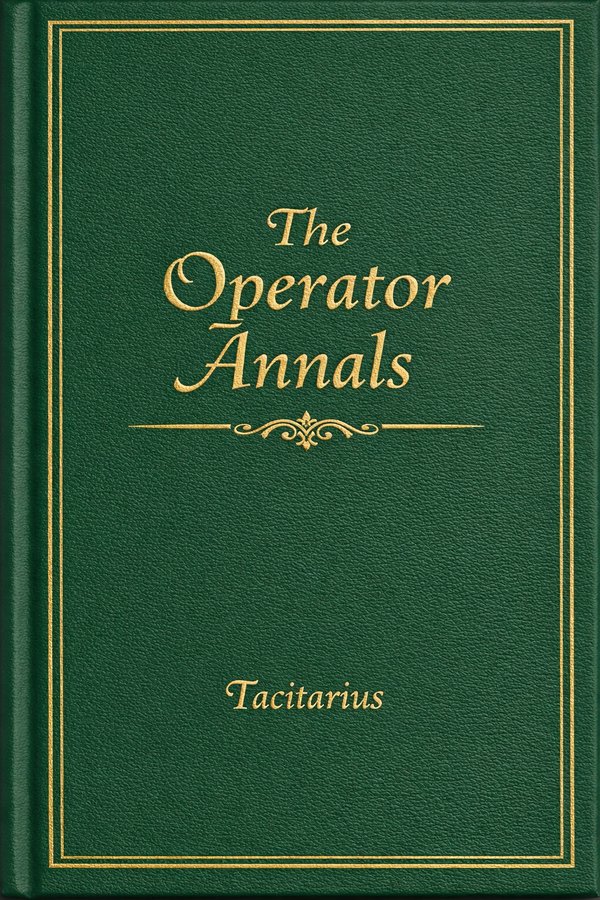
The judge's reasoning
Hills has built an entire future-history apparatus here, and it holds together with the internal consistency that this subgenre lives or dies on. The chain of consequence from a single silent envelope over Winchester to the collapse of medicine, agriculture, and 'the old economy' is worked through with real logical patience: augmented water ends disease, which ends scarcity, which ends labour, which forces the Civilian/Citizen split and eventually the voluntary demographic contraction of the Great Reduction. That's not decoration — it's a civilisation actually thinking through what post-scarcity does to meaning, and the line 'Humanity had solved its oldest problems, and in doing so, erased the foundations of its civilisation' earns its place as a thesis statement for the whole project.
The book's chosen form — pseudo-academic Annals, complete with an editorial preface retro-fitting Tacitarius's account to later 'harmonic rupture patterns' — is a real and well-executed genre move, the Silmarillion/Foundation-appendix tradition of world-as-document. Readers who come to this kind of book don't want scenes; they want the pleasure of a constructed archive, and the layering of in-world footnote (the Winchester Anomaly framing) over first-person testimony (Tacitarius's Prologus) shows Hills understands that pleasure and is willing to build the scaffolding for it rather than fake a plot he isn't interested in telling.
Where the book costs itself credit is in the repetition of its own closing formula — nearly every chapter ends 'Tacitarius wrote that X represented... In the long view of history, X marks the threshold of...' — which flattens the prose rhythm the further you read. But as a work of speculative architecture, the Annals earns its award on scale and coherence, not on sentence music.

Judged by Eleanor "Nell" Whitcombe — Literary Fiction · Prose & Style
"A sentence either earns its breath or it doesn’t."
Supporting passages
"The collapse was not violent. It was silent , a global exhalation as the ancient burdens of survival evaporated. Humanity had solved its oldest problems, and in doing so, erased the foundations of its civilisation."
A genuinely earned image of consequence — the world-building tracks cause into effect rather than simply declaring wonder.
"Modern harmonic analysis has revealed that the anomaly recorded by Tacitarius in the opening pages of the Annals corresponds precisely to the earliest known pre-echo of the Fragment."
The editorial-preface device signals a writer who knows the pseudo-archival subgenre and commits fully to its conventions.
"Humanity has always feared forgetting. We feared it in the age of paper, in the age of data, in the age of harmonic archives. But forgetting is not loss. It is transition."
A quiet thematic center to the book's real concern — memory, mortality, and continuity across a civilisation's transformation.
Per-axis rubric scores
Every Booky-winning book is scored across all ten craft axes. The award category comes from the top axis; a second axis at or above 75 appears as secondary recognition.
Find out what your book does best.
Submit your book today. Get a real, honest, category-specific Booky — or every dollar back.
Submit Your Book → Screen Another Book