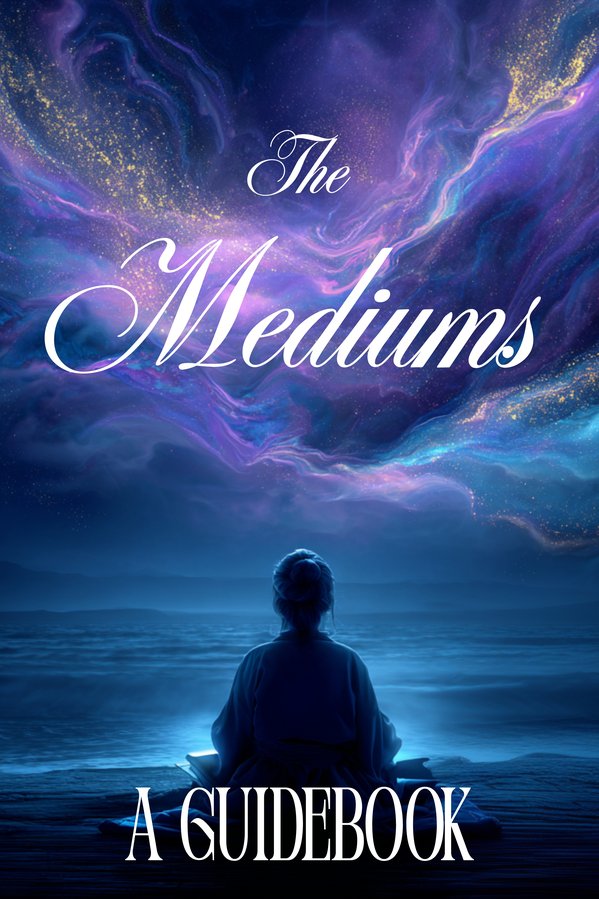
The Mediums; A Guidebook
by Donald Rumer-Rivera
BEST SELF-HELP VOICE BOOKY
Takes you to this book's Amazon page.
The judge's reasoning
This is a guidebook that actually behaves like one. Rumer-Rivera and Grayson don't just gesture at mediumship as a vibe — they build a working taxonomy (clairvoyance, clairaudience, clairsentience, claircognizance, clairgustance, clairalience) and then hand the reader an operational checklist for the hardest problem in the field: telling a psychic hit from a mediumship hit. The "Quick Self-Test: Psychic or Medium?" section, with its three-question diagnostic (Who's speaking? Can I anchor this to identity? Would this be true without a spirit communicator?), is the book's best moment — it's specific, repeatable, and testable in the way genre readers actually want, not vague spiritual reassurance.
The evidential-mediumship framework — "identity first, message second" — gives the whole book a spine. It's reinforced by concrete, well-chosen illustrations: the ring-and-receipt vignette, the "green logo" job-offer example, the uncle who called his niece "Shortstop" and kept his dog tags in the sugar jar. These aren't abstractions; they're the kind of granular detail a reader can actually use to calibrate their own practice.
The personal-history chapters do real work too — Susan's premonition about Houanne ("This will be the last time you will see Houanne") lands with genuine weight because the book doesn't oversell it; she's careful to note she wouldn't have spoken the death outright. Donald's airport story, with its accidental cross-purposes (reading a woman's living mother, only to learn moments later the woman had died), is honestly the strongest single scene in the excerpt — it has real narrative tension and a clean, earned turn.
What holds it back from higher marks is prose that leans on repetition and stock phrasing ("bridge between worlds" recurs often enough to blur), and an originality ceiling — this is a well-trodden genre and the book mostly organizes existing wisdom rather than reframing it. But for readers who picked this up wanting a practical, structured entry into mediumship practice, it delivers exactly what it promises.

Judged by Arthur Beaumont — Non-Fiction · Memoir · Business · Self-Help
"A good non-fiction book changes one specific thing about your week."
Supporting passages
"1. State your intention up front... 2. Ask for a communicator, not a topic... 3. Insist on identity evidence... Then message. Identity first, meaning second—always."
A concrete, repeatable protocol that turns an ambiguous spiritual experience into something a reader can actually practice and self-check.
"Not just 'someone loves you' but 'it's your Uncle Jack who called you 'Shortstop' and kept his military dog tags in the sugar jar.'"
The book's central thesis — evidence over platitude — delivered in a memorable, specific image readers can hold onto.
"She nodded. 'When you came over earlier, I didn't know. I just received the call that she passed. But now your message means more to me than ever.'"
The airport anecdote's turn earns its emotional payoff without overstatement.
Per-axis rubric scores
Every Booky-winning book is scored across all ten craft axes. The award category comes from the top axis; a second axis at or above 75 appears as secondary recognition.
Find out what your book does best.
Submit your book today. Get a real, honest, category-specific Booky — or every dollar back.
Submit Your Book → Screen Another Book