
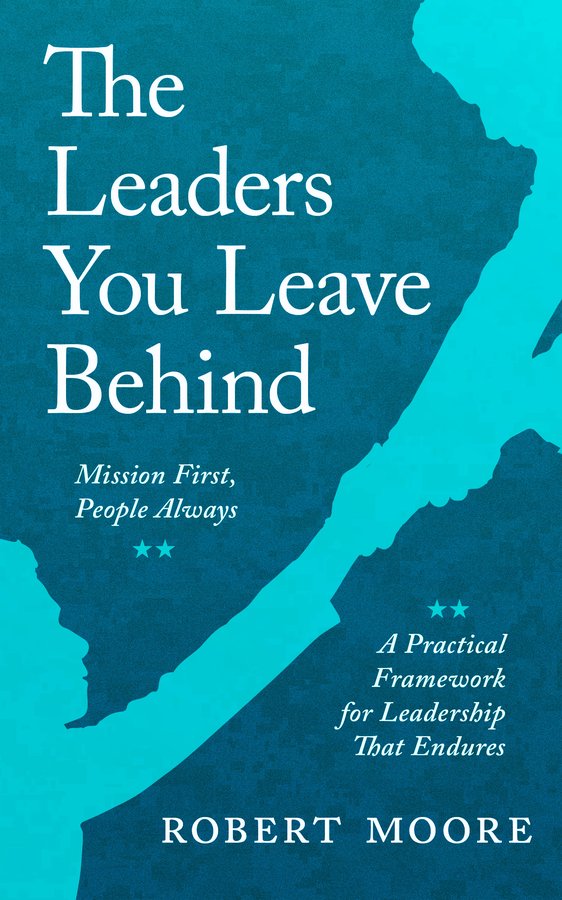
The Leaders You Leave Behind
by Robert Moore
BEST TREATMENT OF MORTALITY BOOKY
Takes you to this book's Amazon page.
The judge's reasoning
Moore's central argument — that "mission first, people always" describes two dimensions of one responsibility rather than competing priorities — is stated cleanly and then actually earns its keep across the opening chapters. He doesn't just assert the synthesis; he works it from multiple angles: the mechanics of discretionary effort, the economics of retention as "capability preservation," and a taxonomy of failure modes (the Mission Tyrant, the People Pleaser) that gives readers a diagnostic vocabulary for their own bad habits, not just their bosses'. The John vignette — a technician sliding into unreliability who turns out to be burned out and unsupported — is the book's best moment because it refuses the easy ending: Moore doesn't fire John, doesn't excuse him, and shows the actual mechanics of a difficult conversation that produces a real fix. That specificity is what separates this from generic leadership-book vibes.
The book's structural discipline is its second strength. Each chapter closes with graduated "Daily/Weekly/Monthly Practices" that convert principle into checklist — the sergeant major who goes on every convoy ("If I'm asking you to do it, I should be willing to do it first") isn't just an anecdote, it's paired with an actionable prompt. That's the difference between a memoir with leadership garnish and an actual self-help framework: a reader closes chapter one with something to try Monday morning.
Where it's thinner: the prose leans on repetition-as-emphasis (the mission-first/people-always refrain, restated dozens of times) rather than earning resonance through scene, and the military-to-civilian bridge sometimes tells us the parallel is powerful rather than dramatizing it. But for the category it's aiming at — practical leadership development grounded in lived authority — it delivers.

Judged by Arthur Beaumont — Non-Fiction · Memoir · Business · Self-Help
"A good non-fiction book changes one specific thing about your week."
Supporting passages
"The breakthrough insight is that taking care of your people is mission accomplishment."
States the book's organizing thesis in a single sentence that the rest of the chapter goes on to justify with mechanism, not just assertion.
"Once I understood the situation more fully, we developed a plan together... If he was struggling, he was expected to tell me rather than just trying to power through."
A concrete managerial scenario with a specific, replicable fix rather than an abstract platitude about compassion.
Per-axis rubric scores
Every Booky-winning book is scored across all ten craft axes. The award category comes from the top axis; a second axis at or above 75 appears as secondary recognition.
Find out what your book does best.
Submit your book today. Get a real, honest, category-specific Booky — or every dollar back.
Submit Your Book → Screen Another Book