
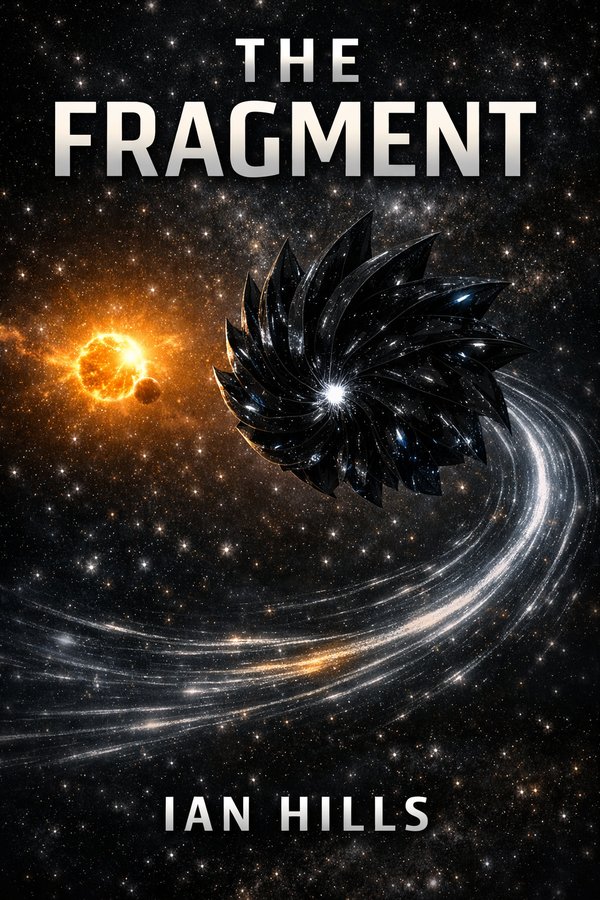
the fragment
by ian hills
BEST ALTERNATE HISTORY BOOKY
Takes you to this book's Amazon page.
The judge's reasoning
Hills has built a genuinely coherent physics-of-perception for this universe, and it's the strongest thing here. The Operator vessels are described through a consistent design philosophy — 'Nothing on an Operator vessel was sharp. Nothing intruded' — and that same principle of curvature-over-edge recurs in the Institute's training halls, the gate architecture, even the breathing discipline the empaths are taught. The Gate Network is rendered with a nice, unforced image: 'The gate hung ahead of them like a perfect idea given form. It did not glow or radiate. It simply existed.' That's a world built from a single aesthetic idea (smoothness, alignment, coherence) carried all the way down to sentence structure and social ritual, which is harder to sustain than it looks.
The genre execution follows from that: this is meditative, procedural SF in the Le Guin/psi-corps tradition, and it commits fully to its own rules — empaths are trusted specialists, not mystics to be doubted, and the captain's 'I always have' believed her without a beat of manufactured skepticism. The escalating three-word confirmations ('It was looking at us') land as intended reveal beats.
What holds this back from a higher ceiling is repetition at the sentence level — 'faint and patient,' 'quiet certainty,' and the breath-cadence recur almost verbatim across scenes rather than varying with tension. But the world itself is imagined with real discipline, and that's what a reader of contemplative SF is here for.

Judged by Eleanor "Nell" Whitcombe — Literary Fiction · Prose & Style
"A sentence either earns its breath or it doesn’t."
Supporting passages
"The gate hung ahead of them like a perfect idea given form. It did not glow or radiate. It simply existed, suspended in a region where the continuum behaved with unusual clarity."
A world-building image that renders an abstract physics concept as something visually and emotionally graspable without over-explaining it.
""It was looking at us.""
The novel's core reveal delivered in three words, trusting the reader and the genre's slow-build conventions rather than over-narrating the moment.
"The cost of perception was not the strain. It was the responsibility. To feel what others could not. To sense what instruments could not measure."
Names the book's central thematic concern — the burden of sensitivity — directly and without sentimentality.
Per-axis rubric scores
Every Booky-winning book is scored across all ten craft axes. The award category comes from the top axis; a second axis at or above 75 appears as secondary recognition.
Find out what your book does best.
Submit your book today. Get a real, honest, category-specific Booky — or every dollar back.
Submit Your Book → Screen Another Book