
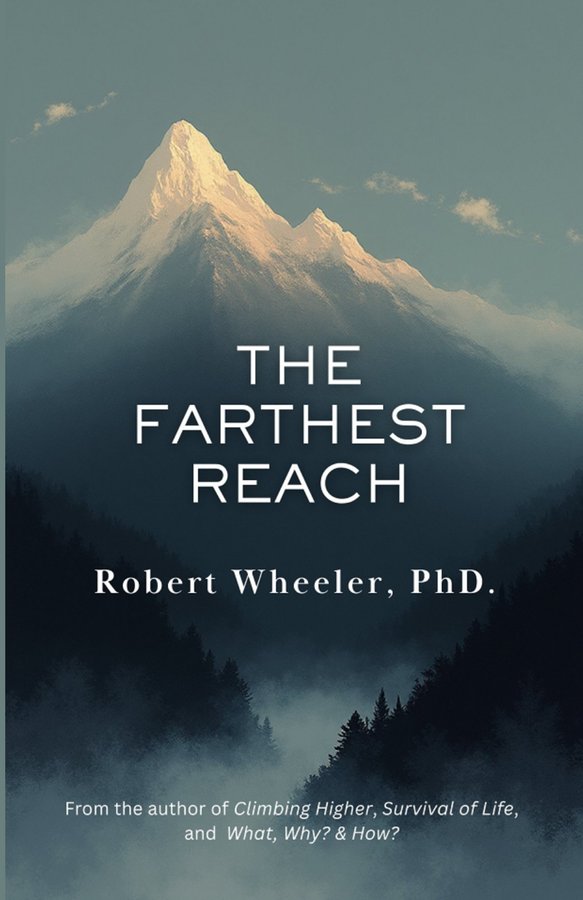
The Farthest Reach
by Robert J Wheeler
BEST TREATMENT OF AGEING BOOKY
Takes you to this book's Amazon page.
The judge's reasoning
Robert Wheeler is, by his own account, ninety-plus years into a genuine, lifelong wrestling match with the question that gives the book its title: why am I here, and what should I do about it. That sincerity is the book's real asset. The preface's autobiographical thread — a father lost at age four, a wartime detour into engineering, a late-life pivot into psychology because "philosophy was too general, theology was too narrow, and psychism was too fuzzy" — is the one place where the manuscript has a pulse and a person behind it, and it's a shame the book doesn't stay there longer.
What follows is less an argument than a taxonomy. Chapter 1 marches through animism, polytheism, monotheism, deism, pantheism, panentheism, idealism, panpsychism, materialism, scientism, naturalism, dualism, neutral monism, and pluralism in the space of a few pages — genuinely useful as a compressed survey of worldview options, and Wheeler's own coinages ("ontological imperative," "sense-of-purpose" with its four components of framework, commitment, perspective, and values) show an actual research career underneath the prose, not just borrowed vocabulary. The SOP measure in particular is the book's most substantive offering: a testable construct with real citations (Frankl, Emmons, Hooker/Masters/Park) that could function as an actual self-assessment tool for a reader wondering whether their own "big questions" are being addressed.
The execution around that substance is uneven — repetitive framing ("how nice it would be if media, politicians, and educators emphasized..." recurs almost verbatim three times), production artifacts left in the text, and a tendency to assert sweeping societal causation (declining religion → rising crime and suicide) without the evidence to earn it. But the underlying intellectual project — a personal, decades-long attempt to build a workable worldview framework — is real and occasionally lands, particularly in the SOP framework and the four-part taxonomy of "reality" (personal, universal, existential, pragmatic) in Chapter 4.
Judged by Arthur Beaumont — Non-Fiction · Memoir · Business · Self-Help
"A good non-fiction book changes one specific thing about your week."
Supporting passages
"I developed a measure about one's "sense-of-purpose" (SOP) consisting of four components: 1) framework--the degree I think there is a PIL; 2) Commitment--the degree to which I am concern about PIL; 3) Perspective-- the degree to which I am succeeding in learning about this framework; and 4) Values--the nature and quality of my PIL framework."
A concrete, applicable framework grounded in the author's actual research career, rather than abstract assertion.
"For me, it started when, as a kid. I wondered if there really was a God or a Heaven where people go after death... This focus probably occurred because of my father's death when I was 4 years old and it continued despite unpopularity of the topic."
The personal, biographical root of the book's inquiry — the one passage where lived experience animates the argument.
Per-axis rubric scores
Every Booky-winning book is scored across all ten craft axes. The award category comes from the top axis; a second axis at or above 75 appears as secondary recognition.
Find out what your book does best.
Submit your book today. Get a real, honest, category-specific Booky — or every dollar back.
Submit Your Book → Screen Another Book