
The Excuse Trap
by James P Patterson
BEST SELF-HELP VOICE BOOKY
Takes you to this book's Amazon page.
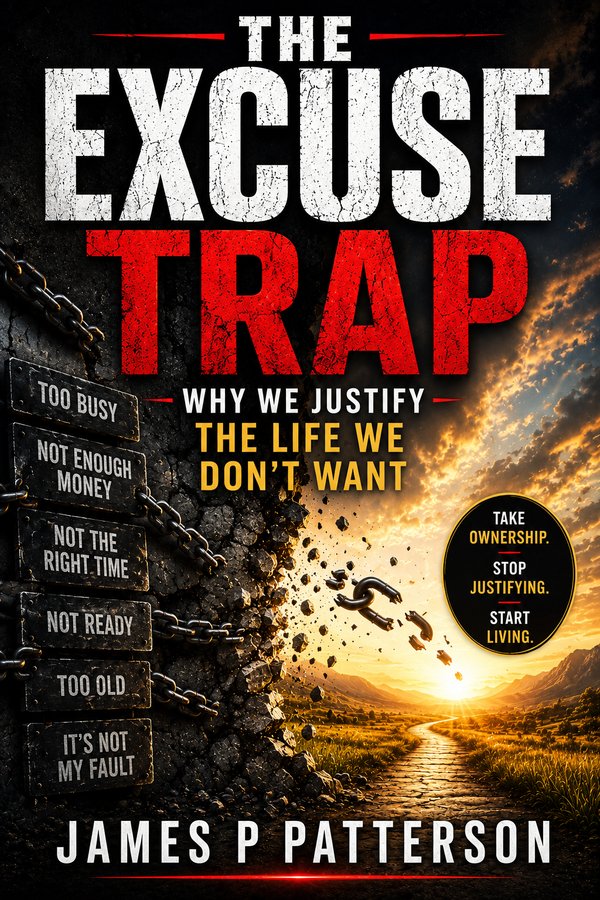
The judge's reasoning
The Excuse Trap does what the best workmanlike self-help books do: it makes a clear, repeatable argument and then refuses to let the reader off the hook. Patterson's central thesis — that excuses are not random failures of will but psychological protection systems rooted in identifiable fears — is stated plainly in Chapter 1 and then systematically demonstrated across five distinct excuse categories (time, money, age, circumstances, logic). That structure is the book's real achievement. Rather than a loosely connected cluster of motivational vignettes, this is a book with a spine.
The chapter on fear (Chapter 3) is the strongest. The passage distinguishing fear of failure from fear of success — noting that "success often brings increased responsibility, higher expectations, and greater visibility" — gives readers a category of self-sabotage they rarely name aloud. That's the kind of thing a self-help book should do: rename something familiar so the reader can finally see it.
The time chapter lands a genuinely uncomfortable observation: "time reflects priorities more accurately than intentions ever will." It's not a novel idea, but Patterson earns it by working through the logic carefully rather than asserting it as an aphorism and moving on.
The prose is clear and consistent — occasionally over-reliant on parallel sentence construction, which can flatten intensity — but it never becomes opaque or preachy in a way that breaks the reader's trust. For its intended audience, this book delivers specific, nameable takeaways in a format they can act on by the end of each chapter.

Judged by Arthur Beaumont — Non-Fiction · Memoir · Business · Self-Help
"A good non-fiction book changes one specific thing about your week."
Supporting passages
"Excuses are powerful because they provide immediate relief. They allow people to avoid discomfort without feeling irresponsible. They protect the ego from failure and shield individuals from the uncertainty that accompanies meaningful change. An excuse can transform inaction into something that feels justified."
This is the book's thesis in four sentences — clean, direct, and immediately recognizable to the reader it's written for, which is exactly the opening move a strong self-help book needs to make.
"Many people assume confidence comes before action. They believe successful individuals felt completely ready before moving forward. In reality, confidence is often the result of action rather than the cause of it. People gain confidence by doing difficult things, learning from mistakes, and proving to themselves that they can handle challenges. Waiting for confidence before acting is often like waiting for strength before entering a gym."
The gym analogy is the kind of concrete, transferable formulation that readers actually remember and repeat — the hallmark of self-help that earns its keep.
"The life you want may require effort, sacrifice, patience, and courage. It may involve setbacks and uncertainty. What it does not require is permission from your excuses."
Punchy, quotable, and precisely calibrated for the audience this book is chasing — the kind of line that ends up highlighted on a Kindle and posted to social media.
Per-axis rubric scores
Every Booky-winning book is scored across all ten craft axes. The award category comes from the top axis; a second axis at or above 75 appears as secondary recognition.
Find out what your book does best.
Submit your book today. Get a real, honest, category-specific Booky — or every dollar back.
Submit Your Book → Screen Another Book