
The dress that had to be made
by felipe rodriguez
BEST TREATMENT OF HOPE BOOKY
Takes you to this book's Amazon page.
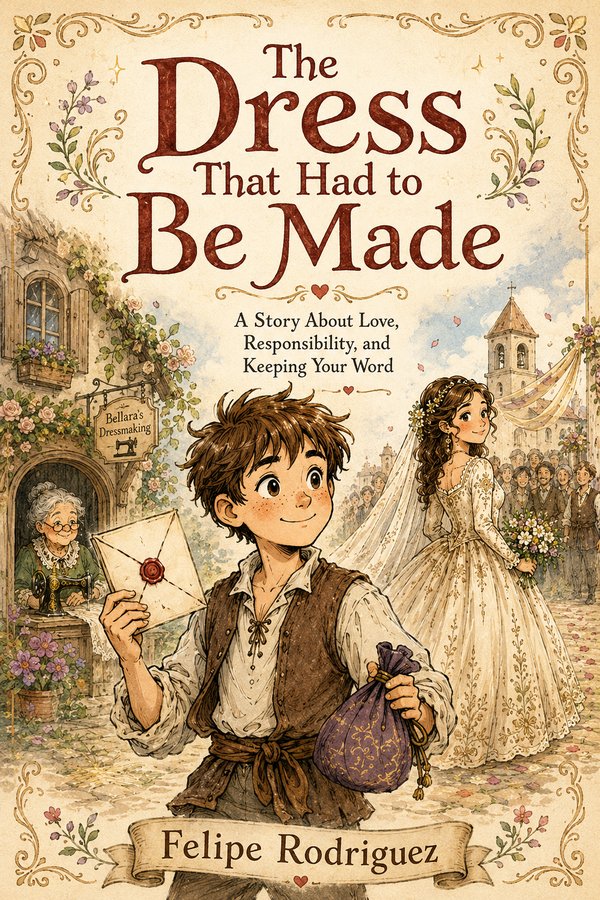
The judge's reasoning
This is a fable, not historical fiction in any meaningful sense — there's no period specificity, no researched texture of a real past, just a generic pseudo-medieval village that exists to host a moral. Judged on its actual terms (a parable for young readers about initiative and follow-through), the thing it does competently is structure: a clean quest engine with escalating obstacles that each force a small decision. The broken bridge, the three contradictory directions, the moment in Pine Hollow where Spud considers going home — these beats are placed with real discipline, each one restating the book's single question ("Does this change what needs to be done?") without becoming repetitive to the point of collapse. Rodriguez understands the shape of a fable well enough to make Bellara's refusal in Chapter 10 the actual climax rather than the river crossing — that's a sound instinct, since the emotional stakes of "can he persuade her" outrank "can he cross water."
The theme is stated so plainly it borders on didactic — the closing sermon and reflection questions turn the book into a workbook rather than trusting the story to do the work alone. But within its genre (values-driven fable for younger or reluctant readers, closer to Aesop or a corporate leadership parable than to literary historical fiction), the throughline is legible and the moral earns at least partial dramatization rather than being purely asserted: Spud's negotiating a cheaper boat fare, his "If I leave without it, I definitely miss the point" line, his blunt honesty with Bellara ("Because I gave my word") all show the theme rather than just tell it.
Prose is plain to the point of flatness, dialogue is functional rather than distinctive, and the historical setting is wallpaper. But the mechanical plotting — problem, obstacle, next useful step, repeat — is the book's genuine skill, and it will land with its intended young/family readership.

Judged by Eleanor "Nell" Whitcombe — Literary Fiction · Prose & Style
"A sentence either earns its breath or it doesn’t."
Supporting passages
"He asked himself the question that had followed him since he left home. Does this change what needs to be done? No."
The refrain structures every obstacle in the book into a single repeatable decision-point, which is the backbone of the whole plot.
"Responsibility means understanding what you promised to accomplish and continuing to think when the easy answer disappears."
States the book's thesis plainly, and the preceding chapters have at least partially dramatized it through Spud's choices rather than only asserting it.
Per-axis rubric scores
Every Booky-winning book is scored across all ten craft axes. The award category comes from the top axis; a second axis at or above 75 appears as secondary recognition.
Find out what your book does best.
Submit your book today. Get a real, honest, category-specific Booky — or every dollar back.
Submit Your Book → Screen Another Book