
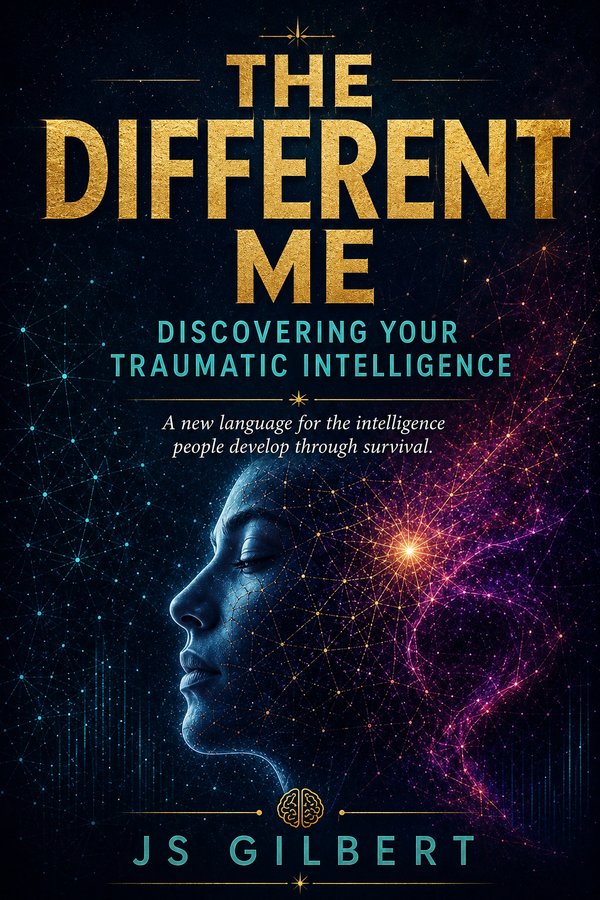
The Different Me
by JS Gilbert
CLEANEST PROSE BOOKY
Takes you to this book's Amazon page.
The judge's reasoning
JS Gilbert has found a voice for a subject that typically loses itself in either clinical detachment or therapeutic treacle — and that voice is the real achievement here.
The prose in The Different Me operates on a sharp, dry frequency that most self-help authors can't sustain for a chapter, let alone a book. The opener of Chapter One — "Nobody wakes up one day and decides to become exceptionally good at reading micro-expressions, predicting volatile behavior, and keeping their cool in a crisis. You earn those skills. Unfortunately, the curriculum tends to be brutal." — establishes a tone of wry authority that earns the reader's trust immediately. This isn't the voice of someone performing expertise; it's the voice of someone who has lived inside the material and learned to find the dark comedy in it.
That voice holds. The description of the amygdala as "an extremely thorough security alert system that never, ever, goes off duty" lands both as science and as recognition — the reader laughs and winces at the same time, which Gilbert explicitly identifies as a hallmark of traumatic intelligence itself. The structural transparency — tables, checklists, bolded call-outs — never feels mechanical because the prose between them has enough personality to make the scaffolding feel intentional rather than compensatory.
On Originality: the concept of "traumatic intelligence" as a named, chartable, self-assessable framework is a genuine gap-fill in the self-help landscape. Gilbert correctly observes that PTG research exists, resilience books exist, trauma memoirs exist — but no one had assembled the full operational picture. The PTGI-to-TI mapping in Table 1.2 is a legitimately useful piece of synthesis that gives the book its intellectual spine.
For its target reader — someone who has spent years being told their capacities and their difficulties are the same problem — this book offers something specific and rare: a framework that says both things are true, and here's why.

Judged by Arthur Beaumont — Non-Fiction · Memoir · Business · Self-Help
"A good non-fiction book changes one specific thing about your week."
Supporting passages
"Nobody wakes up one day and decides to become exceptionally good at reading micro-expressions, predicting volatile behavior, and keeping their cool in a crisis. You earn those skills. Unfortunately, the curriculum tends to be brutal."
Three sentences that do the work of a preface — the dry final clause earns both the subject's gravity and the book's tonal contract with the reader.
"Read that table again. Every single domain of formally measured post-traumatic growth maps directly onto what we're calling traumatic intelligence. This is not a coincidence; it is confirmation. The PTGI has been documenting the upside of trauma for almost thirty years. What this book does is take that framework and ask: what do these abstract domains really look like in the real life of a real person?"
This is the book's clearest statement of its original contribution — not new data, but a new translation layer between formal research and lived self-understanding.
"The goal of integration is not to undo the brain's adaptations (you'd be voluntarily giving up the gifts) but to bring the executive brain back online as a partner to the survival brain, rather than a hostage to it."
A precise, practical articulation of the book's central thesis that a reader can carry out the door and actually use.
Per-axis rubric scores
Every Booky-winning book is scored across all ten craft axes. The award category comes from the top axis; a second axis at or above 75 appears as secondary recognition.
Find out what your book does best.
Submit your book today. Get a real, honest, category-specific Booky — or every dollar back.
Submit Your Book → Screen Another Book