
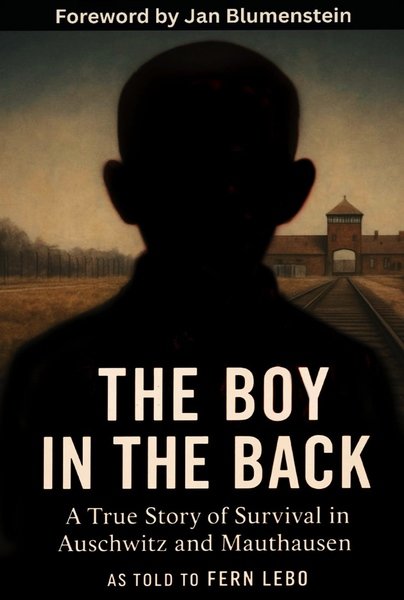
The Boy in the Back; A True Story of Survival in Auschwitz and Mauthausen
by Fern Lebo
MOST SEARCHING MEMOIR BOOKY
The judge's reasoning
A good non-fiction book changes one specific thing about your week. This one gives you a precise, usable idea and then shows it under the worst pressure imaginable: the strategy of being 'the boy in the back.' Jan Blumenstein's survival method is not a vague appeal to resilience. It is a set of concrete, repeatable tactics. At Birkenau he reads the soup barrel and stands near the end of the line, not at the very back, to catch the potato skins. He keeps his eyes down at roll call. He builds a mental wall by counting seconds, steps and cracks in the barracks wall. It is a coherent argument about how a sixteen-year-old stays alive in a killing system, and the book earns it with evidence from the machine shop, the infirmary and the death march.
The book is most honest where invisibility fails or costs him. In the Appellplatz selection he breaks his own rule: he wants to be chosen, stands tall, and is picked last. The chalk-dust chair is a small, terrifying moment of what the author calls cruelty as game. The Russian bridge worker's reply to the drowning men, 'Everybody's replaceable,' stays with the reader precisely because Jan tells it with so little ornament.
The lived sense of the world is the book's other strength. The brick factory, the cattle car, Block 21, the lathe, Mauthausen and Gunskirchen are rendered through texture and small sensory fact, and the cruelty of the Kapos is shown at close range. The unsentimental closing arc, from Pier 21 to a medical practice, shows what survival bought. The long contemporary Israel/antisemitism interludes interrupt the narrative rhythm, but they serve the author's stated purpose, and the testimony itself carries real weight.

Judged by Arthur Beaumont — Non-Fiction · Memoir · Business · Self-Help
"A good non-fiction book changes one specific thing about your week."
Supporting passages
"Invisibility became my greatest ally. The less noticeable I was, the less likely I was to be singled out for punishment or labor or death. I kept my eyes on the ground, avoided eye contact, and moved quietly."
This states the book's central survival thesis plainly and gives the reader a concrete behavioral strategy, not an abstraction.
"It took me only two days to discover how to get an edge which meant being patient and standing at the back of the line or close to it... If you rushed to the front of this wretched army of starving boys, you got only water, so it was important to gauge where the end of the barrel and therefore the bits of potatoes might be."
A specific, observed detail of camp life that shows how calculation, not luck, shaped survival.
"Next to me, one of the boys on the wagon stood up, pointed towards the floundering swimmers and shouted in Russian: 'Look! What's happening there? Aren't you going to do something? Those men are going to drown.' ... 'What for?' he said. 'Everybody's replaceable.'"
A post-liberation moment that lands hard because the narrator reports it flatly, and the line recurs as a lifelong corrective.
Per-axis rubric scores
Every Booky-winning book is scored across all ten craft axes. The award category comes from the top axis; a second axis at or above 75 appears as secondary recognition.
Find out what your book does best.
Submit your book today. Get a real, honest, category-specific Booky — or every dollar back.
Submit Your Book → Screen Another Book