
The Birds and Bees of Leadership
by MART D RATLIFF
BEST ARGUMENT BOOKY
Retailer link provided by the author.
The judge's reasoning
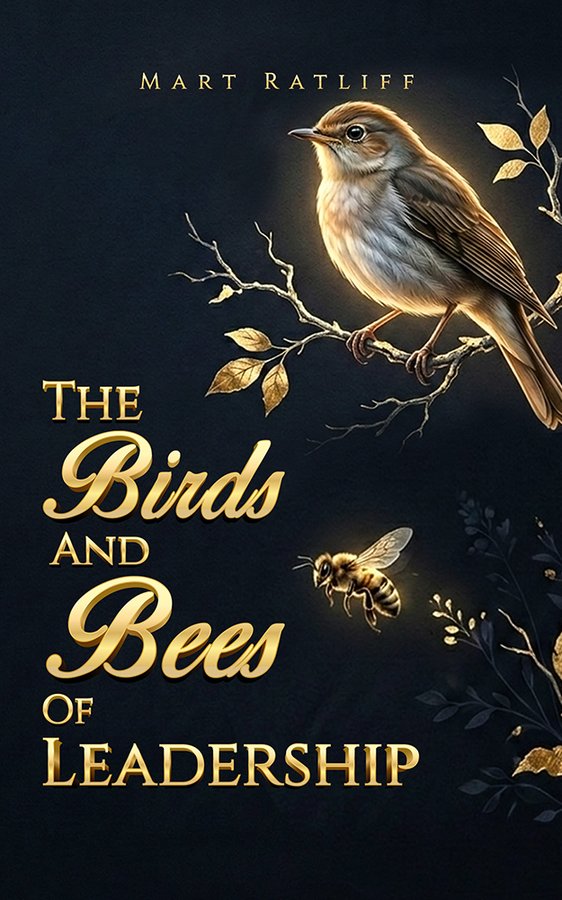
Ratliff's book makes a real argument, and it holds from the first chapter to the last: a leader's behavior under pressure is the signal the whole organization learns from, whether the leader intends it or not. His anchor image, the honeybee queen who "cannot pretend" because her pheromone output simply is her condition, does the work most business books need a stack of case studies to do. He then extends it: the hive reflects the queen's actual state, not her ambitions, and your organization reflects you, not your values wall.
The substance is practical. The coined idea of "time-to-clarity," the gap between a decision and the organization's ability to act on it without private side-conversations, gives leaders something measurable to look for. The three-channel account of signal (what you do under pressure, what you tolerate, what you notice) names things most readers have felt but never itemized. The 2 a.m. email is a small, exact example: the team reads the timestamp, not the disclaimer.
His best choices are the ones where he turns the lens on himself. The Haiti story, where a vague no-fraternization order compressed as it traveled and a boy was beaten for an MRE, is a vivid case of transmission failure. The Jacob chapter lands because the author gives himself the damning line: "I didn't tell you because you made it clear that results mattered more than reasons." The ribbons and challenge coins show reinforcement design in action, with one rule, naming exactly what you saw, that turns praise into conditioning.
The book earned a Booky because it changes specific things about a leader's week: what you do in the first thirty seconds after bad news, and what you say to the person who brings it.

Judged by Arthur Beaumont — Non-Fiction · Memoir · Business · Self-Help
"A good non-fiction book changes one specific thing about your week."
Supporting passages
"The colony is what the queen is, and not what she wants to be, or how hard she is working, or what she is attempting to do to make up for her worsening health."
The central claim, stated through the biology rather than asserted, and it carries the argument for the rest of the book.
"Time-to-clarity is the amount of time that passes between something being communicated... and the organization as a whole understanding what that communication means without each person having to work it out for themselves in secret."
A new, usable diagnostic that gives leaders something concrete to watch for in the hours after they speak.
"My mom died during that time. Stage 4 cancer. I was trying to work while she was in hospice. ... I didn't tell you because you made it clear that results mattered more than reasons. I didn't want to look weak."
The author accuses himself through a former employee's words, which makes the signal argument personal and costly rather than abstract.
Per-axis rubric scores
Every Booky-winning book is scored across all ten craft axes. The award category comes from the top axis; a second axis at or above 75 appears as secondary recognition.
Find out what your book does best.
Submit your book today. Get a real, honest, category-specific Booky — or every dollar back.
Submit Your Book → Screen Another Book