
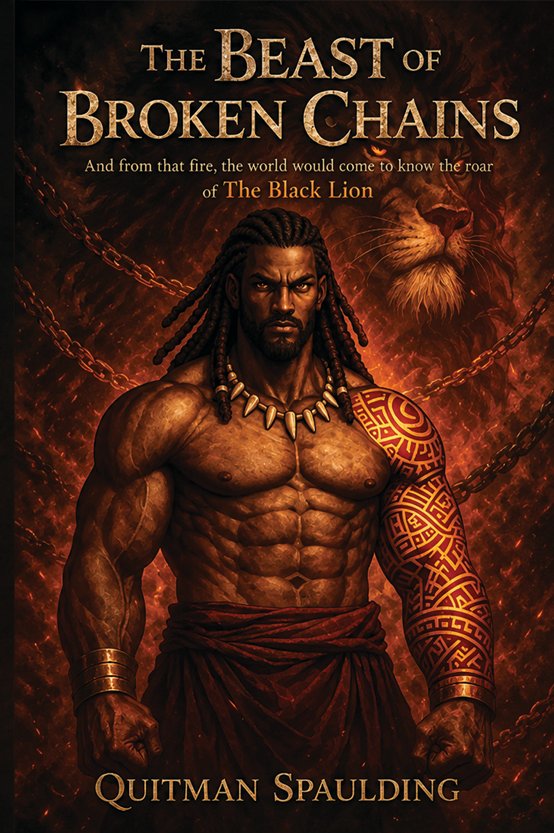
The Beast of Broken Chains
by Quitman Spaulding
BEST INTERNALLY CONSISTENT WORLD BOOKY
Takes you to this book's Amazon page.
The judge's reasoning
Spaulding is building something genuinely ambitious: a mythic-historical spine that runs from tenth-century Nubia through Thebes, the Viking north, and the slave port at Elmina, treating each as a fully populated world rather than a backdrop. The Kushite opening — giants who "wrestled in the dust at dawn" and "debated philosophy under the moonlight" — sets up a civilization with texture before it's destroyed, which makes the destruction land. The Elmina chapter is the book's strongest stretch: "The markets were lined with chains — iron forged for wrists, necks, and ankles. Families were torn apart as if love were a thing that could be sold by weight." That single image does more work than pages of exposition elsewhere, and the choice to root an immortal-vigilante fantasy in the actual machinery of the transatlantic trade gives the book a moral seriousness that pulp revenge narratives usually skip.
The theme running underneath — immortality as witness rather than gift — is stated almost too often ("Memory is the price of purpose"), but it's a real idea the book keeps returning to with variation: through the Viking king Erik's death, through the freed girl who tells him "you came back," through the New World shaman's warning that "memory without purpose is grief." The scope is the book's ambition and its risk — a single lifetime story would let scenes breathe longer — but for a reader who wants a centuries-spanning mythic history of vengeance against enslavers, built from real ports and real griefs, this delivers a world worth walking through.

Judged by Eleanor "Nell" Whitcombe — Literary Fiction · Prose & Style
"A sentence either earns its breath or it doesn’t."
Supporting passages
"The markets were lined with chains — iron forged for wrists, necks, and ankles. Families were torn apart as if love were a thing that could be sold by weight."
Grounds the mythic frame in the specific, brutal architecture of the slave port at Elmina.
"Immortality had cursed me with solitude, but it had also made me witness. And witnesses, in time, become reckoners."
States the book's central argument about memory and moral obligation with real economy.
"She smiled faintly. "My grandmother told me of you. The man who walks the centuries. The lion who never dies." For the first time in ages, I felt the sting of tears."
A quiet beat where the protagonist's isolation briefly cracks open.
Per-axis rubric scores
Every Booky-winning book is scored across all ten craft axes. The award category comes from the top axis; a second axis at or above 75 appears as secondary recognition.
Find out what your book does best.
Submit your book today. Get a real, honest, category-specific Booky — or every dollar back.
Submit Your Book → Screen Another Book