
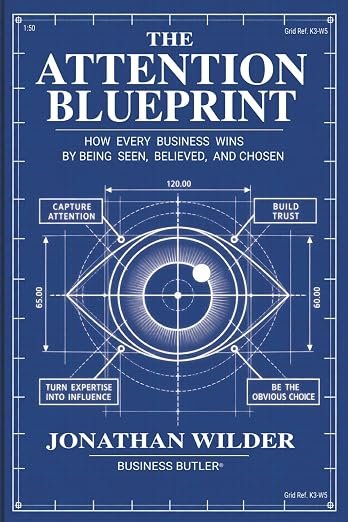
The Attention Blueprint: How Every Business Wins by Being Seen, Believed, and Chosen
by Jonathan Wilder MBA
MOST ACTIONABLE BUSINESS BOOKY
The judge's reasoning
The Attention Blueprint does what a practical business book should: it hands the reader a named tool in every chapter and a Monday-morning assignment at the end of it. Wilder builds a complete, interlocking toolkit. The Attention Ladder (Noticeability, Clarity, Memorability, Preference), the Ignore-Proof Filter, the Content Business Stack, the Belief Stack, the Value Loop and the Four Pillar Maturity Matrix all feed one thesis, that "attention is not luck, it is an engineered outcome." Each chapter follows the same dependable rhythm of story, framework, "Butler's Assignment," and takeaway. The closing Action Plan then collects every exercise with page references, so a reader can actually use the book, not just agree with it.
The strongest material is the before-and-after case work. The hotel whose signs read "Restaurant" and "Bar," the accounting firm that swapped "comprehensive external audit services" for "We protect what three generations built," and the Brightline cleaners who turned a monthly observation form into a retained-client machine are all specific, vivid and easy to retell. His observation that most customers leave through "perceived indifference" and not failure gives the retention chapters real weight. The Disneyland passage is the most personal writing in the book and shows the voice the manuscript could use more of.
Two cautions for the author's next edition. Many figures ("delivered 40% lift," "churn down 18%") come from composites, which the copyright page discloses but the narrative rarely signals. A few chapters also reuse the same stories and slide toward repetition.

Judged by Arthur Beaumont — Non-Fiction · Memoir · Business · Self-Help
"A good non-fiction book changes one specific thing about your week."
Supporting passages
"Attention is not luck. It is an engineered outcome."
The thesis is stated plainly in the introduction and then carried through every framework and assignment, which is exactly what makes the book usable.
"Weak packaging destroys good products. It does so silently, without accountability, because the product takes the blame for the packaging's failure."
A sharp, reusable diagnostic that reframes why good offerings get abandoned and gives owners a concrete question to ask before killing one.
"We had been in the information business. We gathered data, processed it, and presented it back to clients. We were basically a very expensive mirror. What we needed to become was a guidance system."
A memorable, quotable reframe from the financial-planning case that captures the book's practical promise in two sentences.
Per-axis rubric scores
Every Booky-winning book is scored across all ten craft axes. The award category comes from the top axis; a second axis at or above 75 appears as secondary recognition.
Find out what your book does best.
Submit your book today. Get a real, honest, category-specific Booky — or every dollar back.
Submit Your Book → Screen Another Book