
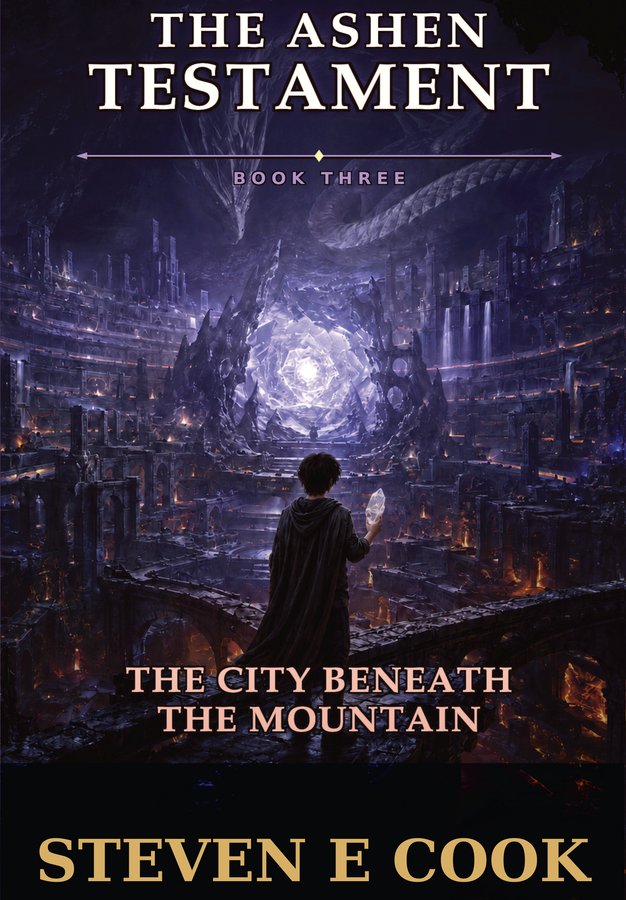
The Ashen Testament The City Beneath the Mountain
by Steven E Cook
MOST ORIGINAL MAGIC SYSTEM BOOKY
The judge's reasoning
Cook has built a mythology where consent, memory, and the machinery of law are load-bearing structural elements — not decorative themes bolted onto a quest plot. Ir-Kar is a genuinely original creation: a city that survives not through brute conquest but through bureaucratized theft of agency, its nine furnaces literally consuming 'names,' 'consequences,' 'apology,' and 'the difference between a gift and a debt.' That's a magic system built from moral categories, and it's rare to see abstraction rendered this concretely — the drop of luminous glass that erases the word 'free' from an entire captive population, and the horrifying quiet aftermath where nobody panics because the very concept of refusal has been surgically removed, is one of the best set-pieces I've read this cycle.
The worldbuilding pays off in theme rather than spectacle. Liora's confrontation with Sevet ('Who changes it when the Keeper is wrong?') dramatizes the book's real argument — that oppression doesn't require lies, only the absence of one relationship between fact and agency. Tovin's trial, with its refusal to let verdicts resemble certainty ('every proposed judgment had to name the person who would bear its cost'), extends the same idea into political structure. Even Dorian's field of resurrected, unaccusing dead ('They did not condemn him. They asked to be counted') turns a stock 'ghosts of guilt' trope into something colder and more exacting.
The prose occasionally leans on aphorism ('Neither does refusal') more than it needs to, and being Book Three, new readers will feel the weight of unexplained history. But the ideas are load-bearing, the execution is disciplined, and the mountain testifies exactly as promised.

Judged by Dr. Aiyana Reyes — Science Fiction · Fantasy · Horror · Speculative
"A world earns belief one detail at a time."
Supporting passages
"The first furnace consumed names, burning the distance between what a person was called and who had the right to call them. The second consumed consequences, allowing intention to survive after harm had been edited away."
A magic system built entirely from abstract moral categories, rendered as literal, functioning infrastructure.
"You may carry salt and still refuse the keeper... Who answers for the work. Who may stop it. What happens after."
The novel's central argument — that oppression survives on true facts arranged to hide one missing relationship — voiced in a single exchange.
""He asked," Corin said through clenched teeth. "I said yes." "You can consent to a risk and still resent what somebody does with it," Miren snapped."
Terse, character-revealing dialogue that compresses the book's consent theme into a battlefield exchange.
Per-axis rubric scores
Every Booky-winning book is scored across all ten craft axes. The award category comes from the top axis; a second axis at or above 75 appears as secondary recognition.
Find out what your book does best.
Submit your book today. Get a real, honest, category-specific Booky — or every dollar back.
Submit Your Book → Screen Another Book