
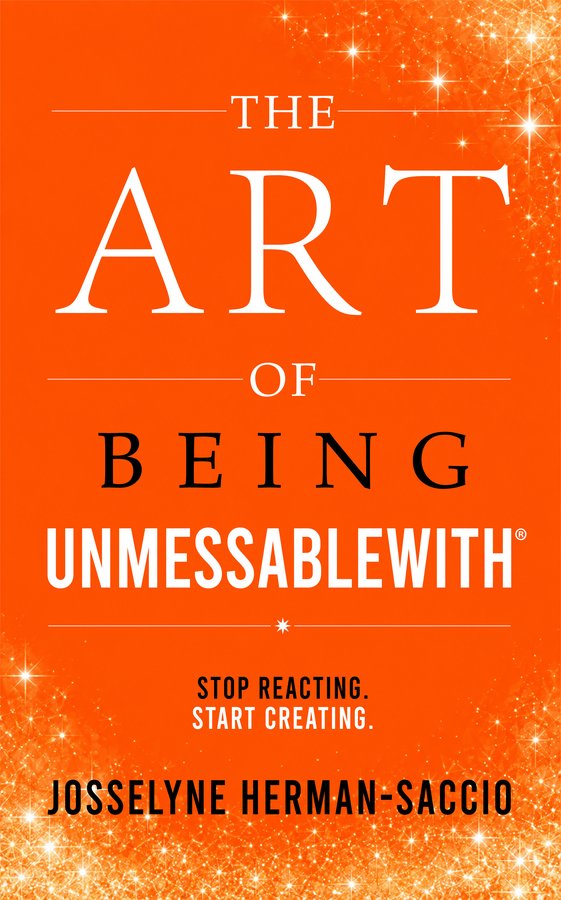
The Art Of Being Unmessablewith: Stop Reacting. Start Creating.
by Josselyne Herman-Saccio
BEST SELF-HELP VOICE BOOKY
Retailer link provided by the author.
The judge's reasoning
Self-help lives or dies on one test: can the reader change something specific by Friday? The Art of Being Unmessablewith passes it, repeatedly and on purpose.
The book is built as a working system. The three worlds (Reaction, Performance, Word) give the reader a map. Chapter 3 supplies the field tools: physical and linguistic red flags, a body-based "hack" (Jonas's three discreet foot stomps under the table on a date), and a pre-created menu of actions so nobody has to improvise while the amygdala is shouting. Chapter 6 rebuilds the calendar around the reader's vision. Chapter 7 offers the Merlin Planning Process in seven steps. Chapter 8 rests on one disciplined test: "If you cannot film it, it isn't an action." That sentence alone will change how a manager debriefs a bad quarter.
The examples earn their place because they are concrete and a little uncomfortable. A five-year-old sells beaded Q-tips for $397 and the episode becomes a $250,000 benefit. Herman-Saccio phones her estranged father-in-law on Father's Day. The spa owner nearly fires two employees before listening to the recorded sales calls. The book is also honest about its limits: it says outright that being Unmessablewith is not about denying feeling, and that a created context can't replace leaving an abusive situation.
The prose is plain, coachy, and repetitive by design. The "Game on!" refrain and the capitalized Word will not suit every reader, and a few claims (neuroplasticity, the "Aramaic" abracadabra) are stated more confidently than they are sourced. But the voice is a real personality, and the book does what a reader picking up a self-help title wants most: it gives them something to do tomorrow morning.

Judged by Arthur Beaumont — Non-Fiction · Memoir · Business · Self-Help
"A good non-fiction book changes one specific thing about your week."
Supporting passages
"If you cannot film it, it isn't an action."
A single usable test that turns vague self-reporting ("stayed connected") into observable behavior a reader can schedule, measure, and repeat.
"It is never what other people say that messes with you; it's what YOU say about what they say that impacts you."
The book's central argument in one line, grounded by the author's own story of inheriting "you can't do your art as your career" from her father at age five.
"I am going to be. Michael didn't know he was teaching me anything that night. He was simply doing what he said he'd do, whether it was easy or convenient."
The payphone call at exactly ten o'clock makes the idea of honoring your Word feel like trust rather than discipline, and it lands with real warmth.
Per-axis rubric scores
Every Booky-winning book is scored across all ten craft axes. The award category comes from the top axis; a second axis at or above 75 appears as secondary recognition.
Find out what your book does best.
Submit your book today. Get a real, honest, category-specific Booky — or every dollar back.
Submit Your Book → Screen Another Book