
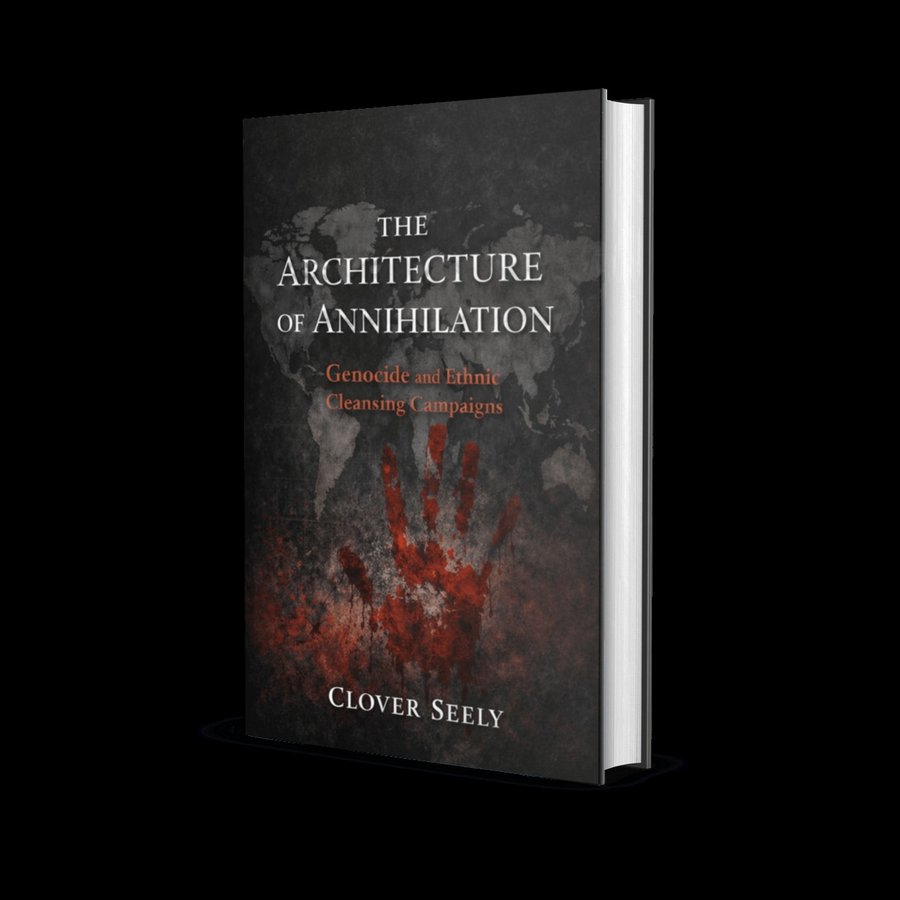
The Architecture of Annihilation: Genocide and Ethnic Cleansing Campaigns
by Clover Seely
MOST RELEVANT READ BOOKY
Takes you to this book's Amazon page.
The judge's reasoning
Seely has taken on a genuinely difficult brief — synthesizing the legal, historical, and moral history of genocide and ethnic cleansing across 46 case studies from Neo-Assyrian deportations to Nagorno-Karabakh — and she does it with real intellectual seriousness rather than mere cataloguing. The opening move, explaining that Karen survivors had to coin the word myo dong because their language had no term for their own eradication, is a smart way into the book's actual thesis: that the vocabulary of atrocity is itself contested terrain with legal consequences. The book earns its subtitle by tracing how Lemkin's original, expansive conception of genocide was whittled down by the very powers negotiating the 1948 Convention — she doesn't just report this, she argues it matters: 'Lemkin believed the convention to be a failure. He wasn't wrong.' That's a judgment, not a summary.
The structural discipline is the book's second real strength. The introduction states its three organizing questions plainly (what is it, how has it happened, why does it persist), and the chapters that follow — on ethnic cleansing, on genocide, on religion/war/colonialism as accelerants — build toward the case-study encyclopedia rather than just prefacing it. The insistence that 'ethnic cleansing and genocide are not natural acts; they result from choices' gives the whole 46-chapter survey a spine: this is meant to be read as a study of decision-making, not an inventory of horror.
Where it falls short of its ambitions is style — the prose is often repetitive (paragraphs on colonialism and cultural genocide restate themselves almost verbatim a page apart) and reads more like an annotated literature review than a book with a distinct authorial voice. But for readers who want a serious, well-sourced reference work that argues its way through the history rather than just listing it, this delivers.

Judged by Arthur Beaumont — Non-Fiction · Memoir · Business · Self-Help
"A good non-fiction book changes one specific thing about your week."
Supporting passages
"This is not a list of inevitable tragedies. Ethnic cleansing and genocide are not natural acts; they result from choices. Leaders, officials, propagandists, and citizens all chose to act or accept violence against neighbors."
States the book's actual thesis — that atrocity is a chain of decisions, not fate — which gives the case studies a unifying argument rather than leaving them as a horror-inventory.
"The book is structured around three fundamental questions. Firstly, what is ethnic cleansing and genocide? Secondly, how has it been perpetrated throughout history? And thirdly, why does it still continue today, despite seventy years of international law?"
A clean architectural statement that the following 46 chapters actually honor, moving from definition to history to unresolved present-tense failure.
"The Armenians marched into the Syrian desert. The Rohingya were driven into the sea. The Yazidis were sold into slavery. The Tutsi were hunted through Rwanda's hills. They were not statistics or numbers."
A rare moment where the prose breaks from its textbook register into something closer to elegy, insisting on the humanity behind the case-study format.
Per-axis rubric scores
Every Booky-winning book is scored across all ten craft axes. The award category comes from the top axis; a second axis at or above 75 appears as secondary recognition.
Find out what your book does best.
Submit your book today. Get a real, honest, category-specific Booky — or every dollar back.
Submit Your Book → Screen Another Book