
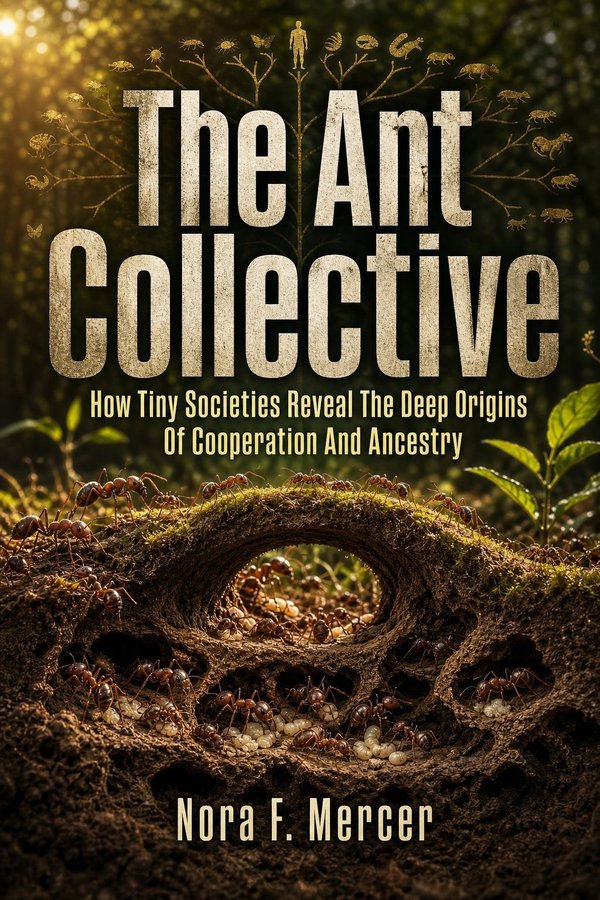
The Ant Collective
by Nora F. Mercer
BEST TREATMENT OF JUSTICE BOOKY
Takes you to this book's Amazon page.
The judge's reasoning
Mercer's real gift here is architectural, not decorative: she builds an argument the way a colony builds a nest — one clean chamber connecting to the next, load-bearing and unshowy. The book's governing idea, that "cooperation is never simply the absence of competition" but "an organized response to competition, infection, and environmental uncertainty," is stated early and then earned across three chapters through concrete escalation — from soil engineering, to kin selection, to the caste/soma analogy in Chapter 3. That's the discipline of good popular science: a thesis that keeps paying interest rather than being restated with new adjectives.
The prose rewards this substance with a steady, unfussy rhythm. Sentences like "Waste is not simply discarded; it is placed where it will do the least harm" show the book's real strength — an economical parallelism that turns biological fact into something close to aphorism without over-reaching into poeticism it hasn't earned. The recurring move of stating what a phenomenon is not before saying what it is ("Policing... is not a moral act; it is an evolutionary mechanism") becomes a genuine structural signature, disciplined enough to feel intentional rather than formulaic.
What keeps this from reaching literary heights is that it's writing for the intellect, not the ear or the heart — there's no character, no scene, and the imagery (soil, trails, mandibles) illustrates rather than lingers. But within its genre, that restraint is the right choice: it never inflates the ant colony into false mysticism, and the caveat late in Chapter 3 — "A worker is not a cell, and a queen is not a literal organ" — shows an author more interested in precision than in a cute metaphor. That's a writer who trusts her subject enough to let it be complicated.

Judged by Eleanor "Nell" Whitcombe — Literary Fiction · Prose & Style
"A sentence either earns its breath or it doesn’t."
Supporting passages
"Their societies endure not by eliminating risk, but by turning risk into a source of new biological solutions."
The book's controlling thesis, compressed into a single earned sentence rather than restated as a slogan.
"Waste is not simply discarded; it is placed where it will do the least harm."
A clean parallel structure that turns a biological fact into something close to aphorism without overreaching.
"The colony becomes more than a gathering of individuals. It becomes a system that can occupy space, store energy, and respond to disturbance in ways a lone insect cannot."
Builds the felt reality of colony-as-system with escalating, concrete claims rather than vague wonder.
Per-axis rubric scores
Every Booky-winning book is scored across all ten craft axes. The award category comes from the top axis; a second axis at or above 75 appears as secondary recognition.
Find out what your book does best.
Submit your book today. Get a real, honest, category-specific Booky — or every dollar back.
Submit Your Book → Screen Another Book