
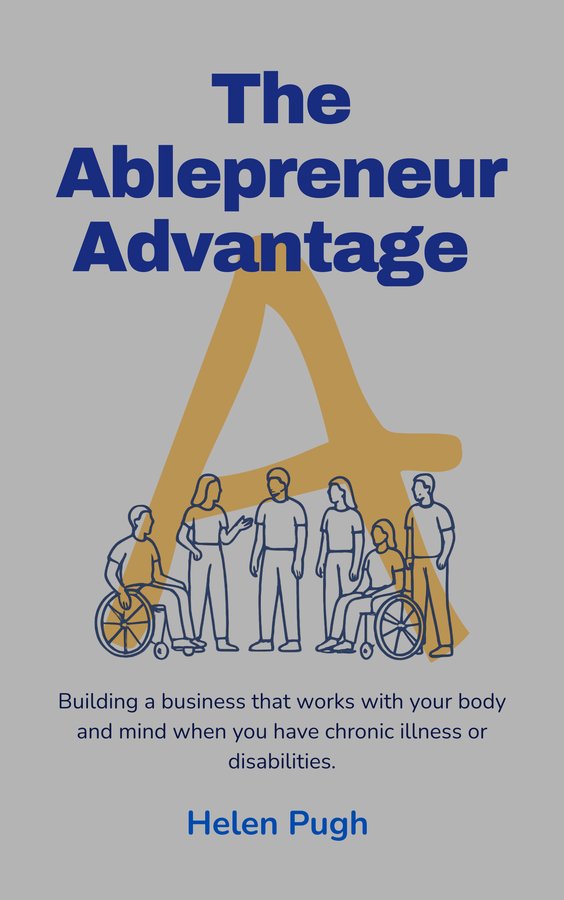
The Ablepreneur Advantage
by Helen Pugh
MOST QUIETLY PROFOUND BOOKY
Takes you to this book's Amazon page.
The judge's reasoning
The Ablepreneur Advantage does something most business books won't: it names a specific, underserved reader — the disabled or chronically ill entrepreneur — and builds a coherent, practical framework around that reader's actual constraints rather than an idealised founder archetype. That's not a reframing exercise or a chapter tacked onto an existing playbook. It's the whole thesis, and Pugh executes it with conviction.
The substance is real. The 60% planning rule — build your week at 60% capacity, leave 40% as a physiological safety net — is precisely the kind of counterintuitive, immediately actionable principle that good business writing lives on. The three-tier energy-day taxonomy (high, medium, low) gives readers a vocabulary for a problem they've been managing wordlessly for years. The Minimum Viable Price and Minimum Viable System framings are borrowed concepts redeployed with genuine contextual fit.
What lifts the book beyond a competent framework dump is Pugh's willingness to be specific about her own failure. The pricing chapter's personal narrative — discovering she was charging minimum wage not from modesty but from internalised devaluation, then wiping her client base and rebuilding — is the kind of scene that earns trust. The detail that she could have charged twice what she was earning is more persuasive than any motivational exhortation. Similarly, the chapter-two confession of sitting in a blanket, laptop open, "tears of frustration burning behind my eyes" while trying to follow a content plan her body had already vetoed, is raw enough to feel true.
The grandmother dedication and the chapter-eight callback to her story grounds the whole enterprise in a lineage of non-performative resilience that gives the book a moral centre most self-help titles lack. This isn't hustle-culture rebrand. It's a principled counter-argument.

Judged by Arthur Beaumont — Non-Fiction · Memoir · Business · Self-Help
"A good non-fiction book changes one specific thing about your week."
Supporting passages
"Planning at 60% means: You stop overcommitting You stop disappointing yourself You stop burning out You stop feeling behind You start succeeding sustainably When you plan for your real capacity, you create space for your best work."
The 60% Rule is the book's most concrete and transferable framework — a specific, memorable prescription that earns the 'practical business book' classification on its own terms.
"The real failure wasn't that I charged too little. The real failure was that I believed that was all I was worth. It took me far too long to realise that the reason so many people wanted to work with me wasn't because I was brilliant, it was because I was cheap."
This self-implicating admission — distinguishing market popularity from genuine valuation — lands with the quiet force of a real reckoning rather than a motivational pivot, and it earns the reader's trust in Pugh's authority.
"This is not a book about overcoming your disability. It's a book about designing a business that doesn't require you to."
A single-sentence hook that cleanly positions the book against every adjacent title in the disability-and-resilience category and immediately communicates the reframe to a reader who has been mis-served by conventional advice.
Per-axis rubric scores
Every Booky-winning book is scored across all ten craft axes. The award category comes from the top axis; a second axis at or above 75 appears as secondary recognition.
Find out what your book does best.
Submit your book today. Get a real, honest, category-specific Booky — or every dollar back.
Submit Your Book → Screen Another Book