
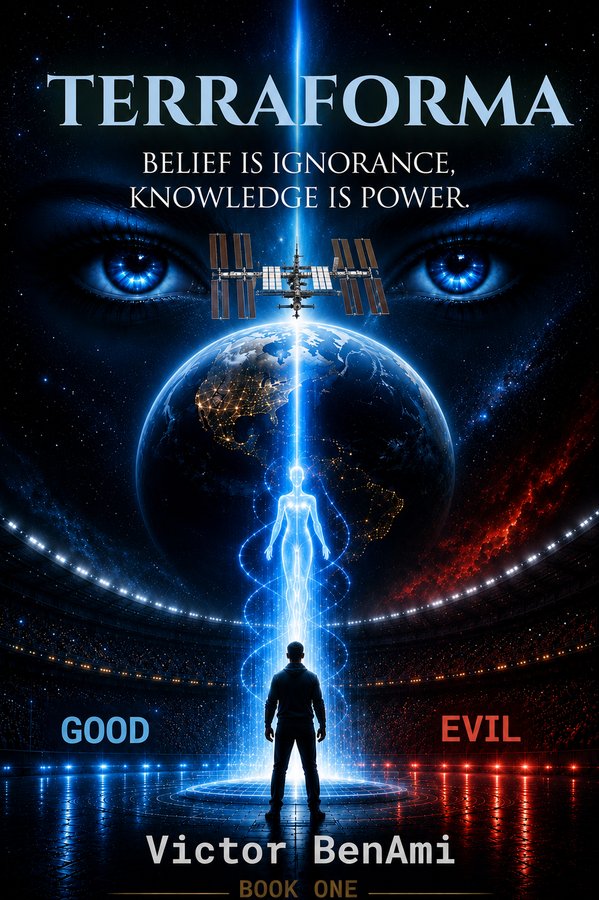
Terraforma, Belief is ignorance, knowledge is power.
by Victor BenAmi
BEST TREATMENT OF FAMILY BOOKY
Retailer link provided by the author.
The judge's reasoning
What distinguishes Terraforma in its opening chapters is that its central idea is dramatized rather than merely announced. Benami builds one traumatic event, a flash flood, a white light, a woman's face, and a voice saying "DO NOT GIVE UP," and then lets three children carry it into three incompatible interpretive worlds. Billy takes the angel on faith and wears it on his chest as an oversized crucifix. Rebecca inherits her mother's "power of the universe" and wonders what pushed her to dial 911. Max, raised on his father's rule that "Belief is ignorance. Knowledge is power," refuses the angel but cannot refuse the experience, and so reasons his way to the meteor and a question he can actually study.
The book's best sustained work is the chapter in which Max visits Billy, hoping to find a fellow witness and finding a rival owner of the answer instead. Maribel's condescending "I only hope God will be merciful toward those who witness His power and still refuse to believe" lands because it is gentle rather than cruel, and the narration earns its closing observation: "He had expected them to share a mystery. Instead, Billy had claimed ownership of the answer." The David and Maribel marriage, a man "competing with Jesus" for his wife's attention, gives that conflict a believable adult root.
The set-up is also well engineered for its genre. A meteor photographed on the porch, a boy's vow made like "a contract," and a hospital nurse's offhand "someone was looking out for them" plant the hook cleanly. The author's preface shows the book is a novel of ideas, and the opening chapters honor that ambition by making the epistemological conflict personal rather than abstract.

Judged by Eleanor "Nell" Whitcombe — Literary Fiction · Prose & Style
"A sentence either earns its breath or it doesn’t."
Supporting passages
"He had expected them to share a mystery. Instead, Billy had claimed ownership of the answer."
Distills the book's central tension, shared experience splintering into competing certainties, into one precise, emotionally legible observation.
"Calling the light an angel explained nothing; it only gave the mystery a name. Yet he had no better answer."
Shows Max reasoning rather than reacting, which makes his turn toward extraterrestrial explanation feel earned rather than imposed.
"Billy stared at the screen for a few seconds, the way he always did when he thought God might be trying to tell him something."
A single gesture establishes Billy's worldview and sets up the friendship's later fracture with economy and gentle humor.
Per-axis rubric scores
Every Booky-winning book is scored across all ten craft axes. The award category comes from the top axis; a second axis at or above 75 appears as secondary recognition.
Find out what your book does best.
Submit your book today. Get a real, honest, category-specific Booky — or every dollar back.
Submit Your Book → Screen Another Book