
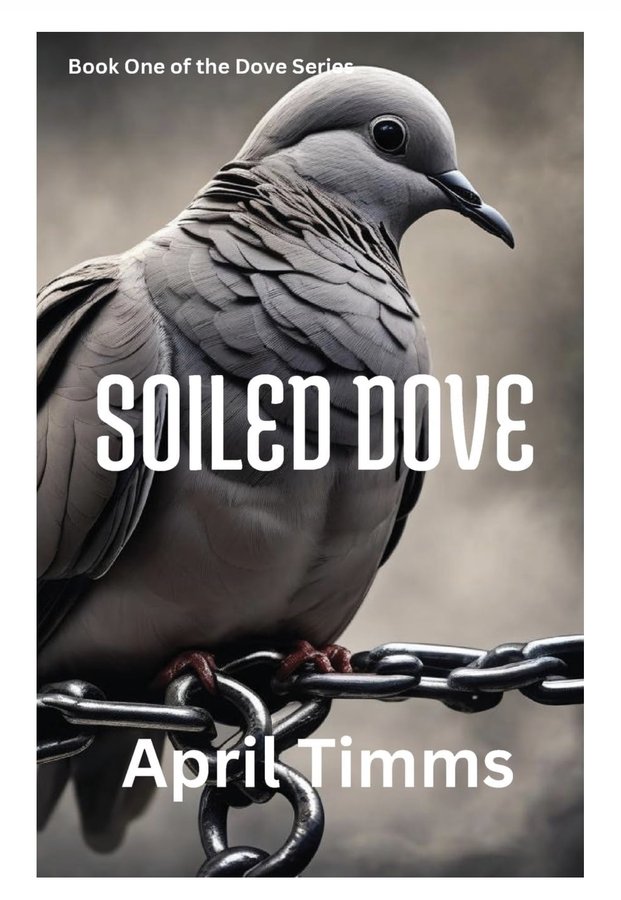
Soiled Dove
by April Timms
MOST HOPEFUL READ BOOKY
Takes you to this book's Amazon page.
The judge's reasoning
Soiled Dove earns its Booky on the axis of Emotional Resonance because April Timms never loses sight of what the story is really doing: accompanying a seventeen-year-old girl through the particular cruelty of a grief that has nowhere to land before a worse blow falls. The scene where Clara rides home from the infirmary in the dark to tend the animals — unable to sit still at her father's bedside because the horses and pigs still need water — is quietly devastating. It is the kind of unglamorous, practical grief that rings true. The moment Daddy calls her "Dove" for the first time in years, just before she walks out the door he has effectively sold her through, carries the weight of an entire lost childhood in two syllables.
Clara herself is the book's most durable strength. Timms renders her as genuinely young in the best sense — capable, resourceful, full of internal commands to herself (Move, feet, move) — without making her passive. The slow dawning horror at the campsite, the panic translated into the practical detail of hiking her dress to her knees to lengthen her stride, is exactly right: a girl who does not yet have the language for what is happening to her but whose body already knows. That instinct for grounding emotional crisis in physical, specific action keeps the sentiment from tipping into sentimentality. The book's readers — those who came for a story of survival and faith tested against trafficking and exploitation — will find the emotional architecture they came for, built on a foundation of genuine feeling rather than melodrama.

Judged by Eleanor "Nell" Whitcombe — Literary Fiction · Prose & Style
"A sentence either earns its breath or it doesn’t."
Supporting passages
"He hadn't called her Dove in years which made a tear sneak down Clara's cheek too. She quietly shut the bedroom door behind her and returned to the man in the front room, who despite the pain of leaving home, did seem to be the savior she was needing."
The gap between the nickname's tenderness and the transaction it follows — Clara still interpreting Clyde as a savior — captures the emotional and dramatic irony of her situation with economy and ache.
"Move feet, move! She willed herself to take one step after another until she found herself standing in the barn. She smelled the familiar scent of her beloved mare Josie before the horse even came into view."
Clara's self-command followed immediately by the involuntary comfort of a familiar smell establishes her as a character whose resilience is bodily and instinctive, not performed — a meaningful distinction for a protagonist who will need every ounce of it.
"Panic set in! She turned back toward the wagon as quickly as the dress would allow, hiking it to her knees in order to have a longer stride."
The corset dress — earlier a symbol of Clara's naive excitement about a wider world — becomes in this moment a literal impediment to escape, a physical detail that does double thematic duty without announcing itself.
Per-axis rubric scores
Every Booky-winning book is scored across all ten craft axes. The award category comes from the top axis; a second axis at or above 75 appears as secondary recognition.
Find out what your book does best.
Submit your book today. Get a real, honest, category-specific Booky — or every dollar back.
Submit Your Book → Screen Another Book