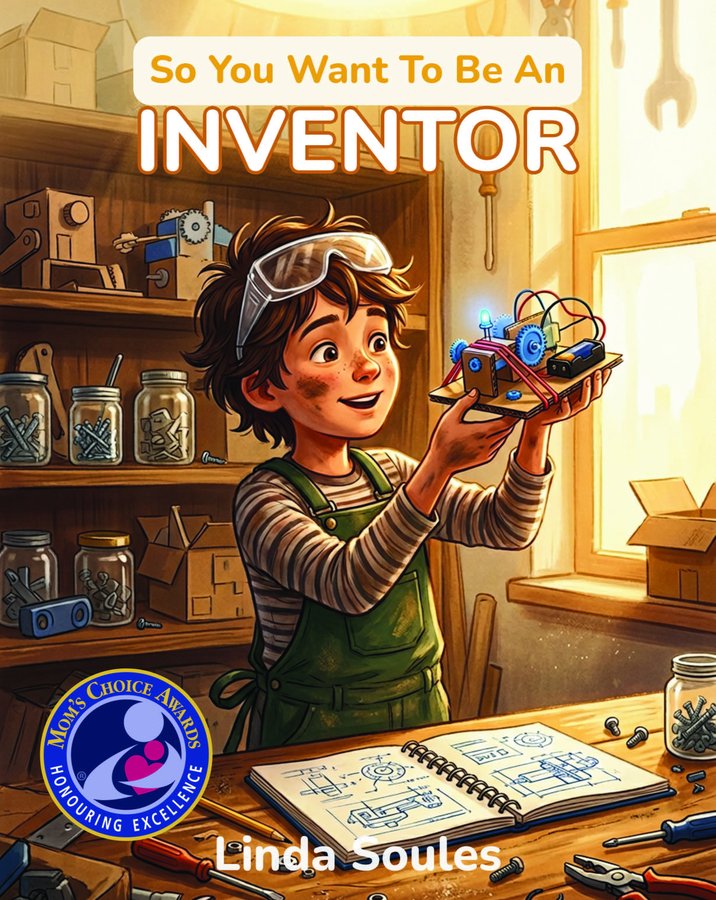
So You Want To Be An Inventor
by Linda Soules
BEST HISTORICAL FICTION BOOKY
Takes you to this book's Amazon page.
The judge's reasoning
So You Want To Be An Inventor does exactly what the best middle-grade nonfiction should do: it treats its reader as someone already halfway there. Linda Soules never condescends. She doesn't explain invention to children so much as she invite them into the inventor's actual experience — the smell of solder and machine oil, the morning pages of half-formed ideas, the twelve jars that finally open with one hand.
The genre execution here is strong precisely because the book resists the most common failure mode of career nonfiction for kids: cheerful vagueness. Instead, Soules gives us a Day in the Life structured around a real, specific invention — a jar opener for people with limited hand strength — and walks through it with enough concrete detail that the reader can feel themselves in the workshop. The sequence of observation → prototype → failure → data → iteration isn't just described; it's enacted structurally across the book's sections.
The prose earns its space. "Invention is iterative and patient and full of wrong turns that turn out to be the map" is the kind of sentence that sticks. The inclusion of Garrett Morgan, Hedy Lamarr, and Gitanjali Rao as the Famous Inventors section — foregrounding a Black inventor working against a hostile patent system, a woman whose contribution was ignored for two decades, and an eleven-year-old — signals clearly who this book believes inventors actually are.
The dedication — For every kid who ever looked at something broken and thought: I can fix that — is the whole book in a sentence. Soules knows exactly which reader she wrote this for, and that reader will feel found.

Judged by Brooke Hayes — Reader-at-Large · Cross-Genre · Emerging Voices
"Every book is the only book for somebody."
Supporting passages
"9:30 AM — You revise the prototype. The device you're working on — a tool for people with limited hand strength to open jars — has a new mechanism. You test it with twenty jar sizes, noting where it slips and where it works."
This specific, grounded Day in the Life vignette does what most career nonfiction for kids never attempts: it makes the work tactile and real rather than aspirational and abstract.
"Invention is iterative (requiring a lot of trial and error) and patient and full of wrong turns that turn out to be the map."
The parenthetical defines the term without breaking rhythm, and the final image — wrong turns as map — is genuinely memorable prose for a middle-grade audience.
"Garrett Morgan invented a breathing hood that saved dozens of trapped workers during a 1916 tunnel disaster under Lake Erie — and because he was Black, he had to hire a white actor to demonstrate it to buyers who refused to meet him."
This passage does the rare thing of teaching systemic injustice and individual ingenuity simultaneously, trusting young readers to hold both truths without softening either.
Per-axis rubric scores
Every Booky-winning book is scored across all ten craft axes. The award category comes from the top axis; a second axis at or above 75 appears as secondary recognition.
Find out what your book does best.
Submit your book today. Get a real, honest, category-specific Booky — or every dollar back.
Submit Your Book → Screen Another Book