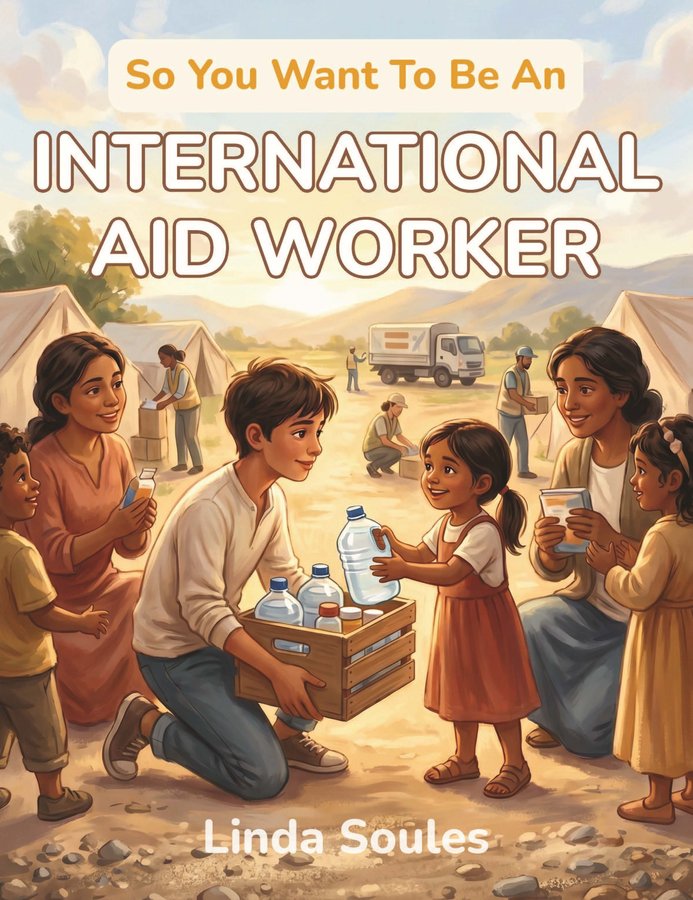
So You Want To Be An International Aid Worker
by Linda Soules
MOST CURIOSITY-SPARKING BOOKY
The judge's reasoning
This book refuses to give kids the postcard version of humanitarian work, and that is its great strength. Linda Soules builds the whole book around one hard idea: help done carelessly can hurt. She makes it land with the checkpoint scene, where you are driving a truck of food and soldiers ask whose side you are on, and with a vivid warning that warehouses in Sri Lanka filled with donated winter coats and stiletto heels after the 2004 tsunami. Nobody told these young readers that SWEDOW ("stuff we don't want") is a real piece of aid slang, and now they know why aid groups ask for money instead of boxes. The book also quietly overturns the savior fantasy. The real heroes of most disasters "never board a plane," and "in humanitarian work, careful is heroic." It is honest about burnout, impossible choices, and the spreadsheet-and-bucket-counting reality behind the heroics.
It works as a middle-grade book because the seriousness is carried by delight: Magawa the landmine-sniffing rat, Clowns Without Borders, a goat eating the distribution list, a peanut paste inspired by a jar of Nutella. The "Pack the Truck!" game and the 15-liter water math put a child inside the work. The profiles of Dunant, Ogata, Salva Dut, Edhi, Jebb, and Nansen show humanitarianism as a human story, and Jebb's wish that her organization "work for its own extinction" echoes the book's best idea. This is a book for the kid who cannot stand to see anyone left out, and it trusts that kid with the truth.

Judged by Brooke Hayes — Reader-at-Large · Cross-Genre · Emerging Voices
"Every book is the only book for somebody."
Supporting passages
"It is a little like doing a friend's math homework for them. It feels kind in the moment, but later leaves them stuck on the test."
A child-sized analogy makes the abstract "do no harm" principle instantly graspable without softening its meaning.
"Aid workers have a nickname for well-meant gifts nobody can use: SWEDOW, short for "stuff we don't want.""
A memorable, specific piece of insider vocabulary delivers a serious lesson about the wrong kind of generosity in a way kids will repeat.
"The arrival of an aid worker tells them otherwise without a word being spoken. Good aid does this through respect."
The book finds the emotional center of humanitarian work, the fear of being forgotten, and answers it with dignity rather than pity.
Per-axis rubric scores
Every Booky-winning book is scored across all ten craft axes. The award category comes from the top axis; a second axis at or above 75 appears as secondary recognition.
Find out what your book does best.
Submit your book today. Get a real, honest, category-specific Booky — or every dollar back.
Submit Your Book → Screen Another Book