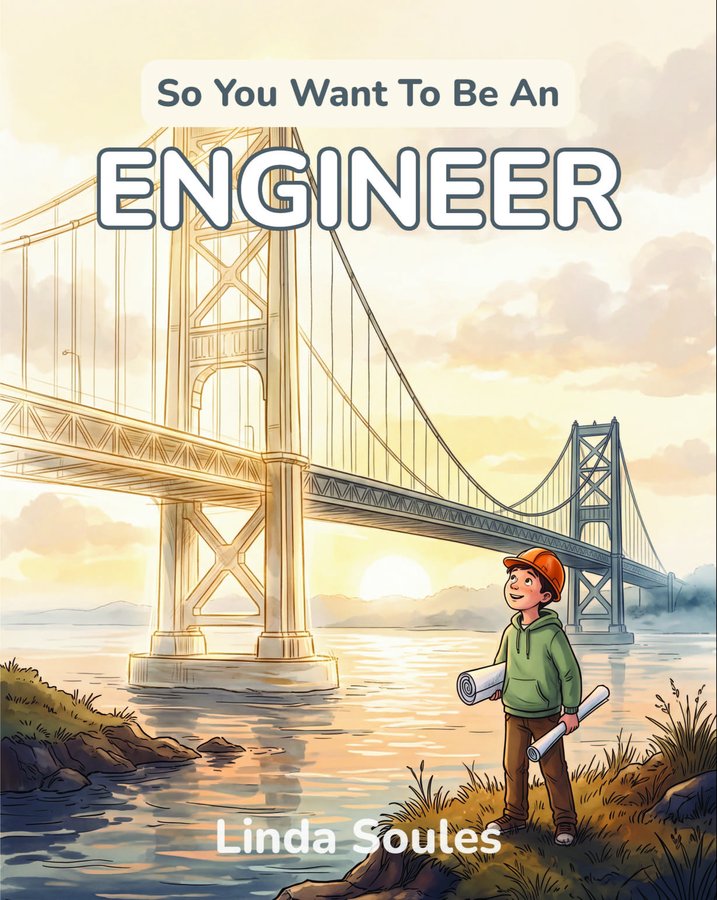
So You Want To Be An Engineer
by Linda Soules
BEST CONVERSATION-STARTER FOR FAMILIES BOOKY
The judge's reasoning
This book makes a real argument, which is rarer in children's career nonfiction than it should be: engineering is the practice of caring about strangers by imagining how things fail. The thesis shows up on the first page ("Their best work is the disaster that never happens") and pays off in the author's closing note, where a former lawyer reframes "What could go wrong?" as "one of the kindest questions a person can ask." That is a thought a ten-year-old can carry for decades.
The evidence earns the claim. The Citicorp Center chapter is the best example. A Princeton student, Diane Hartley, asks about diagonal winds, the building's engineer rechecks his math and finds bolted joints that should have been welded, and crews weld steel plates at night while 2,500 Red Cross volunteers stand ready to evacuate ten blocks. The book ends it with the line "You don't need a license to ask a good one." Tubby the cocker spaniel on Galloping Gertie, the woodpecker that grounded Discovery, and the bread-dropping bird at the Large Hadron Collider keep the tone light without cheapening the lessons about failure.
The practical takeaways are real: build and break something, keep a notebook, reverse-engineer a toaster, try the Marshmallow Challenge. It is honest about the hard parts (design reviews that sting, licensing exams, fewer than one in six engineers being women). The "Day in the Life" section, with the eleven-year-old who can't tie his shoe with the prototype hand, makes the work human. Brisk, witty, and respectful of its young reader. It changes one specific thing about a child's week: they start asking how things fail.

Judged by Arthur Beaumont — Non-Fiction · Memoir · Business · Self-Help
"A good non-fiction book changes one specific thing about your week."
Supporting passages
"Engineers ask those questions before anything is built, so nobody has to learn the answers the hard way. Their best work is the disaster that never happens."
States the book's central argument in two plain sentences, reframing engineering as care for people who never see the work.
"Engineers tell this story to every new generation, because admitting a mistake can be the bravest thing an engineer does. Remember Diane Hartley, too. She was still a student when she asked her question about the wind. You don't need a license to ask a good one."
Turns a gripping true story into a lesson and an invitation for the young reader to see themselves in it.
"You thank him and write down every word. He knows more about this hand than anyone in the building."
The 'Day in the Life' prototype-hand scene makes the child user the expert, showing humility and purpose without a lecture.
Per-axis rubric scores
Every Booky-winning book is scored across all ten craft axes. The award category comes from the top axis; a second axis at or above 75 appears as secondary recognition.
Find out what your book does best.
Submit your book today. Get a real, honest, category-specific Booky — or every dollar back.
Submit Your Book → Screen Another Book