
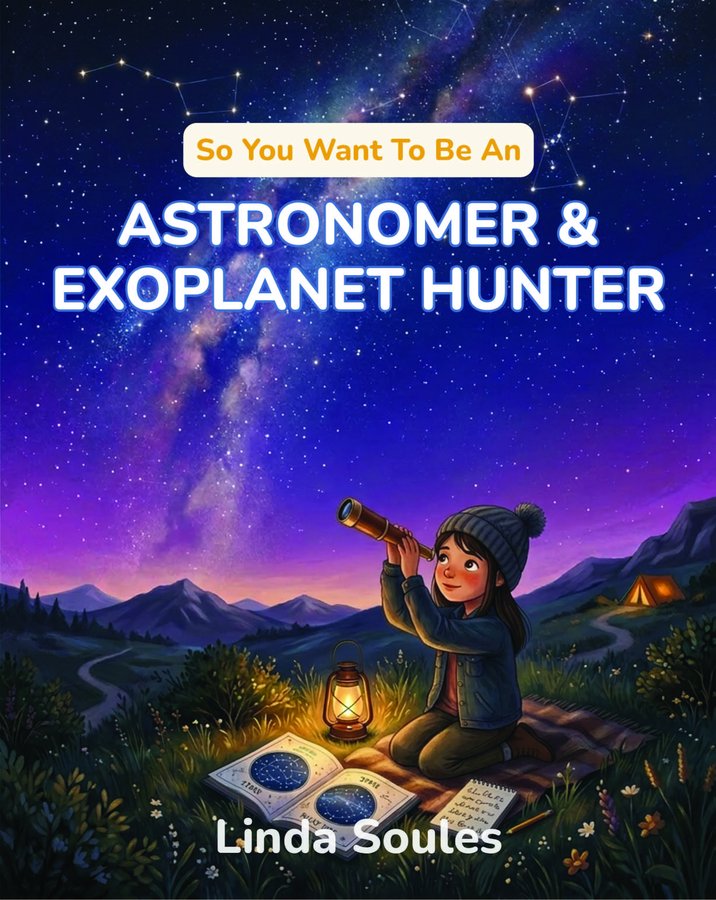
So You Want To Be An Astronomer & Exoplanet Hunter
by Linda Soules
MOST QUOTABLE PROSE BOOKY
Takes you to this book's Amazon page.
The judge's reasoning
Linda Soules has done something genuinely difficult here: she has written nonfiction prose for middle-grade readers that doesn't condescend, doesn't oversimplify, and doesn't lose the wonder in the act of explaining. The voice throughout So You Want To Be An Astronomer & Exoplanet Hunter is confident, warm, and — most impressively — rhythmically alive in a way that career-exploration books almost never are.
Consider the dedication: "For every kid who has looked up / at the night sky and felt, all at once, / very small and very important. / Both of those feelings are correct." That's not filler copy. That's a writer who knows exactly who she's writing for and has decided to meet them at full height.
The prose earns its authority through specific, felt accumulation. The passage on light — "we are not only looking out; we are looking back" — lands because Soules has built to it carefully, letting the reader feel the scale before naming it. The "handshake across deep space" metaphor for the moment of discovery is earned rather than borrowed. And the description of the JWST sunshield — five layers of foil, each thinner than a human hair, keeping the mirror cold enough to detect heat from worlds trillions of miles away — is the kind of specific, astonishing detail that turns a curious child into a future scientist.
The "Day in the Life" chapter is structurally smart: it makes the inverted schedule, the sandwich between targets, the promising dip at 1 AM feel lived rather than summarized. By the time Soules writes "Somewhere in the next week, if you are lucky, one of them will turn out to be a planet that has waited billions of years to be noticed," the reader has been folded into the vigil. That's emotional resonance doing its work through prose craft, not sentiment.

Judged by Brooke Hayes — Reader-at-Large · Cross-Genre · Emerging Voices
"Every book is the only book for somebody."
Supporting passages
"The light you analyzed traveled for years, sometimes centuries, before it ever reached the detector. The planet you found will continue its orbit long after you are gone. For an instant, on a single evening, your attention reached across all of that emptiness and made contact with another world. Astronomers describe the feeling as a handshake across deep space."
This passage shows Soules at her best — building scale and intimacy simultaneously, landing on a metaphor that is original, precise, and genuinely moving without straining for effect.
"The first generation of astronomers searching for true Earth twins began their work knowing they might not be the ones to confirm what they were looking for. They started anyway. That is what a scientist does. You plant the tree whose shade you may never sit under, because someone will."
The tree-planting aphorism here works because Soules has spent the preceding paragraphs making the reader feel the timescale, so the emotional weight lands on earned ground rather than borrowed sentiment.
"Astronomy teaches perspective. The discovery that the Earth is one planet among billions, orbiting one star among hundreds of billions, in one galaxy among trillions, is information that quietly changes how a person stands on the ground. It enlarges the imagination."
Soules articulates the deepest justification for science education with precision and without grandiosity — a rare balance in books aimed at young readers.
Per-axis rubric scores
Every Booky-winning book is scored across all ten craft axes. The award category comes from the top axis; a second axis at or above 75 appears as secondary recognition.
Find out what your book does best.
Submit your book today. Get a real, honest, category-specific Booky — or every dollar back.
Submit Your Book → Screen Another Book