
So You Want To Be An Animator
by Linda Soules
BEST USE OF RHYTHM BOOKY
Takes you to this book's Amazon page.
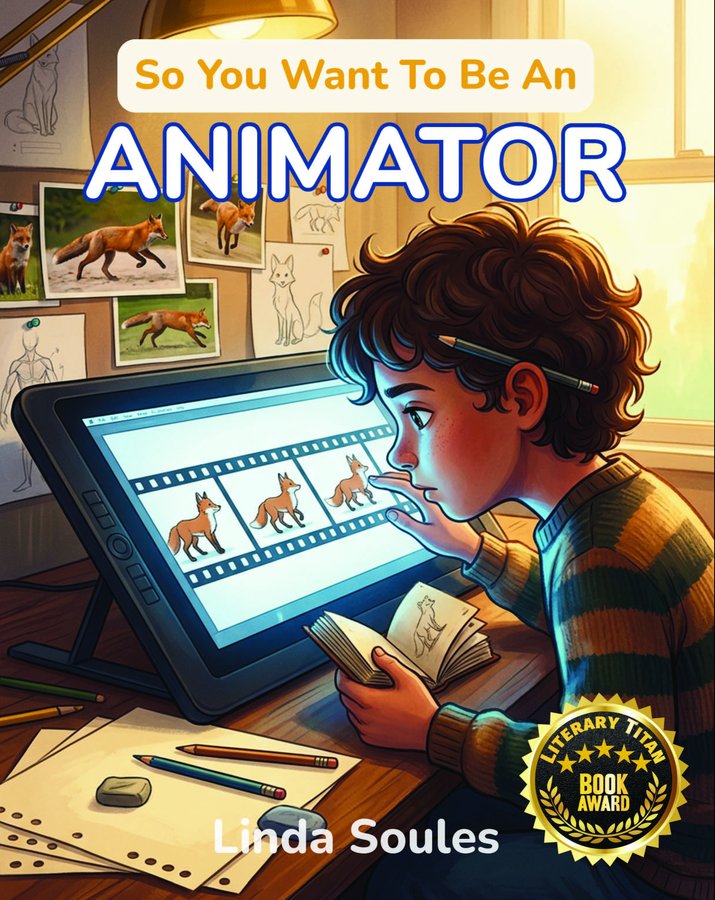
The judge's reasoning
So You Want To Be An Animator earns its Booky on the strength of prose that does something genuinely rare in middle-grade nonfiction: it thinks in images, and it makes those images feel like the subject. The opening move — reaching back thirty thousand years to a bison painted with eight legs in Chauvet Cave, moving in torchlight — is not an arbitrary hook. It is the book's thesis in one image: human beings have always wanted drawings to live. That instinct is then sustained, sentence by sentence, through a voice that earns the right to be lyrical because it is also precise.
The five-role definition of an animator (actor, physicist, timekeeper, observer, marathoner) is a genuinely original piece of structure: it tells a child exactly what this job is by telling them what it requires of a whole person. The ice cream cone scene — twelve seconds of a round orange character looking from empty cone to fallen scoop — is used to explain timing and audience empathy, and it works because Soules commits to the specific detail (twelve seconds, the sniff in the dark theater) rather than retreating into abstraction.
The Author's Note lands with unusual weight for this format: "The audience does not love the drawing. The audience loves the being you put inside the drawing." That sentence belongs in a book about any art form and will travel in the mind of a ten-year-old who reads it. This book knows exactly which child it is for — the one who drew a character in the corner of a notebook — and speaks to that child directly, seriously, and without condescension.

Judged by Brooke Hayes — Reader-at-Large · Cross-Genre · Emerging Voices
"Every book is the only book for somebody."
Supporting passages
"A bouncing ball is movement. A bouncing ball that hesitates before it bounces — as if it is thinking about it — is alive. That hesitation, that tiny pause that makes the audience feel the ball has a mind, is the animator's art."
This passage demonstrates the book's core stylistic gift: building a conceptual distinction through rhythm and repetition, landing the key term ('alive') exactly when the reader has felt the difference rather than merely been told it.
"A character who never existed becomes someone a child carries through hard nights for the rest of their life — a friend they keep in a place no real friend can reach. To be the person who makes that being is a strange and serious privilege."
The Author's Note earns genuine emotional weight here by naming what animation actually does in a child's interior life — not entertainment, but companionship — and by framing that as the moral stakes of the animator's craft.
"Animation has shown children a Japanese forest spirit who waits at a bus stop, a Mexican family lighting candles for the people they have lost, a young Scottish princess refusing to marry, a small robot who falls in love on an abandoned Earth. It has let kids who've never met someone different from themselves spend two hours inside that person's life — and walk out a little more able to imagine being them."
Rather than gesturing generically at animation's cultural value, this passage earns its claim by citing four specific films whose emotional particulars any middle-grade reader will recognize, making the argument concrete and cumulative.
Per-axis rubric scores
Every Booky-winning book is scored across all ten craft axes. The award category comes from the top axis; a second axis at or above 75 appears as secondary recognition.
Find out what your book does best.
Submit your book today. Get a real, honest, category-specific Booky — or every dollar back.
Submit Your Book → Screen Another Book