
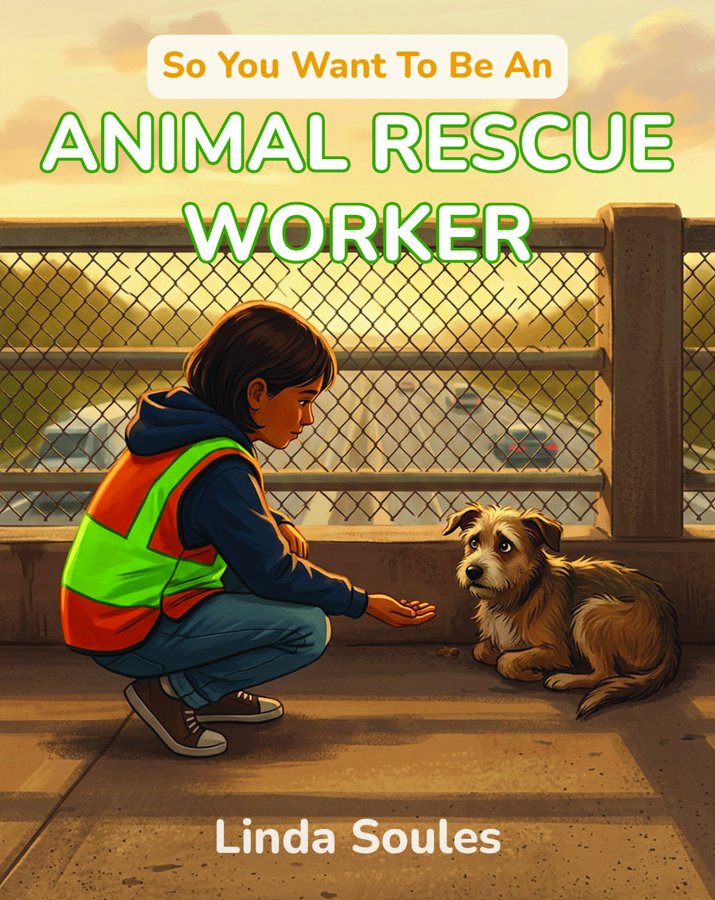
So You Want To Be An Animal Rescue Worker
by Linda Soules
BIGGEST HEART FOR YOUNG READERS BOOKY
Takes you to this book's Amazon page.
The judge's reasoning
Linda Soules's So You Want To Be An Animal Rescue Worker earns its Booky on emotional resonance, and earns it honestly.
This is a nonfiction career book for middle-grade readers, and it could have been a list of facts dressed up with appealing photos. Instead, Soules opens a door — literally and figuratively — and makes you feel what's on the other side of it. The book's organizing metaphor (a shelter door, the threshold between "lost and found, between alone and held, between invisible and seen") is established in the first chapter and paid off consistently, giving the whole piece a structural heartbeat most career guides lack.
The prose does real work for its audience. Sentences like "A dog that lies flat and does not move has given up" are short, specific, and quietly devastating — exactly calibrated for a ten-year-old reader who will feel that land. The day-in-the-life sequence earns its emotional climax without sentimentalizing it: the dog who took a treat from a hand in the morning walks straight to her new family in the afternoon, and Soules closes the scene with "Quietly, you lay a fresh blanket in the empty kennel, ready for whoever comes through the door next." That restraint is the whole craft move, and it works.
The section on qualities — especially "Empathy That Includes the Difficult" — treats young readers as moral actors rather than passive recipients. And the Famous Workers section, particularly the Sterling Davis entry with "You don't lose cool points for compassion," broadens the book's imagined reader in a way that feels intentional and genuinely inclusive.
This is a book a child keeps. That's the test.

Judged by Brooke Hayes — Reader-at-Large · Cross-Genre · Emerging Voices
"Every book is the only book for somebody."
Supporting passages
"That door, the one between lost and found, between alone and held, between invisible and seen, is where every rescue story begins."
This triplet lands the book's central emotional architecture in a single sentence, giving young readers a feeling to carry through every fact that follows.
"Quietly, you lay a fresh blanket in the empty kennel, ready for whoever comes through the door next."
The second-person close of the day-in-the-life sequence is a model of writerly restraint — it earns the emotion by refusing to explain it.
"The best rescue of all is the one that means an animal never had to be rescued in the first place."
Soules gives middle-grade readers a genuinely systemic idea — that the goal is to make the work obsolete — without ever condescending or oversimplifying.
Per-axis rubric scores
Every Booky-winning book is scored across all ten craft axes. The award category comes from the top axis; a second axis at or above 75 appears as secondary recognition.
Find out what your book does best.
Submit your book today. Get a real, honest, category-specific Booky — or every dollar back.
Submit Your Book → Screen Another Book