
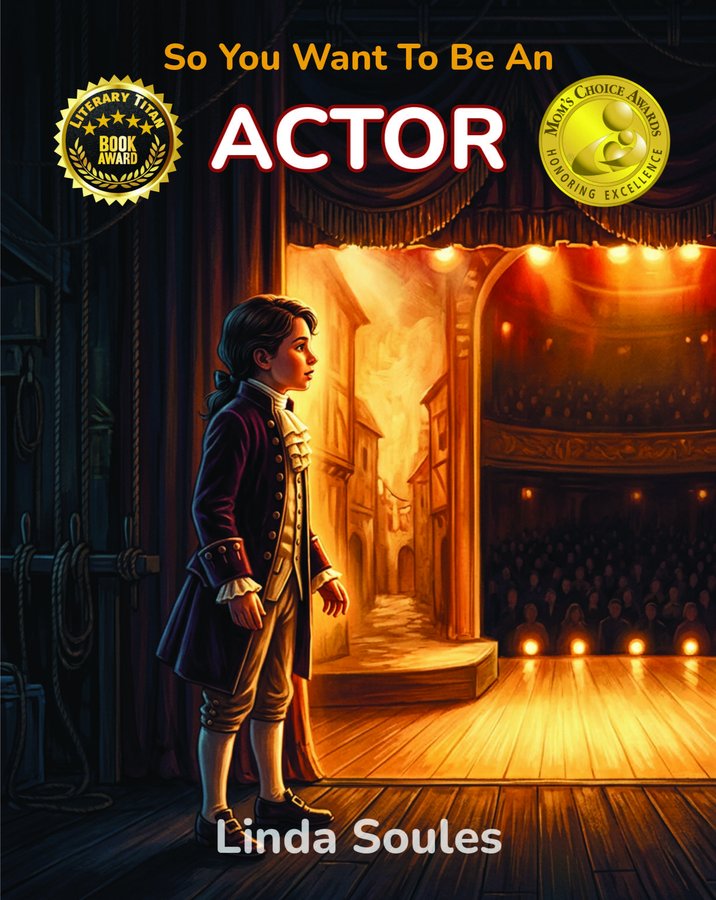
So You Want To Be An Actor
by Linda Soules
MOST PAINTERLY PROSE BOOKY
Takes you to this book's Amazon page.
The judge's reasoning
Linda Soules writes middle-grade non-fiction the way the best teachers talk to kids: straight, warm, and without a hint of condescension. The prose in So You Want To Be An Actor earns its space sentence by sentence. Consider the opening: "You want to take a feeling — a real, human, complicated feeling that most people can barely name, let alone show — and hold it up in the light so that everyone in the room can see it and think: I've felt that too." That's not boilerplate career copy. That's craft — the long dash doing emotional work, the rhythm building to the reader's own recognition.
What distinguishes Soules's style is her capacity for the small, exact image alongside the large idea. The ghost light passage — "It is practical, so nobody trips in the dark. But the legend says it is there to light the way for the ghosts of past performers" — lands as both fun fact and genuine atmosphere. The "veteran performer" anecdote ("Not their head. Their chest. Like someone had reached into the dark theater and touched their heart without asking permission") achieves real emotional resonance without once talking down to a ten-year-old.
The book's structural choices reinforce the prose: section headers double as micro-essays, the glossary closes with "The gentlest landing after the most extraordinary flight," and the "A Note From the Author" earns its keep rather than functioning as filler. For a child who already feels the pull toward performance — or one who hasn't yet found the word for what they're feeling — this book meets them exactly where they are. Every book is the only book for somebody. This one is for that kid.

Judged by Brooke Hayes — Reader-at-Large · Cross-Genre · Emerging Voices
"Every book is the only book for somebody."
Supporting passages
"You want to take a feeling — a real, human, complicated feeling that most people can barely name, let alone show — and hold it up in the light so that everyone in the room can see it and think: I've felt that too."
The syntax itself enacts the actor's work — building through accumulation to the moment of shared recognition — demonstrating a prose style that trusts young readers with genuinely complex ideas.
"I wasn't sad, they said later. I was seen. That actor had somehow shown me a feeling I'd been carrying that I didn't have words for. And suddenly I wasn't alone with it anymore."
This unnamed veteran's memory becomes the emotional core of the entire book, articulating why acting matters in terms a child can feel rather than merely understand.
"Every theater keeps a 'ghost light' — a single bare bulb left burning on an empty stage overnight. It is practical, so nobody trips in the dark. But the legend says it is there to light the way for the ghosts of past performers. The most serious room in the performing arts is also the most haunted."
Soules moves from practical fact to poetic resonance in three sentences, modeling the very quality — finding the emotional truth inside the literal — that the book argues defines great acting.
Per-axis rubric scores
Every Booky-winning book is scored across all ten craft axes. The award category comes from the top axis; a second axis at or above 75 appears as secondary recognition.
Find out what your book does best.
Submit your book today. Get a real, honest, category-specific Booky — or every dollar back.
Submit Your Book → Screen Another Book