
So You Want To Be An Activist
by Linda Soules
BEST CONVERSATION-STARTER FOR FAMILIES BOOKY
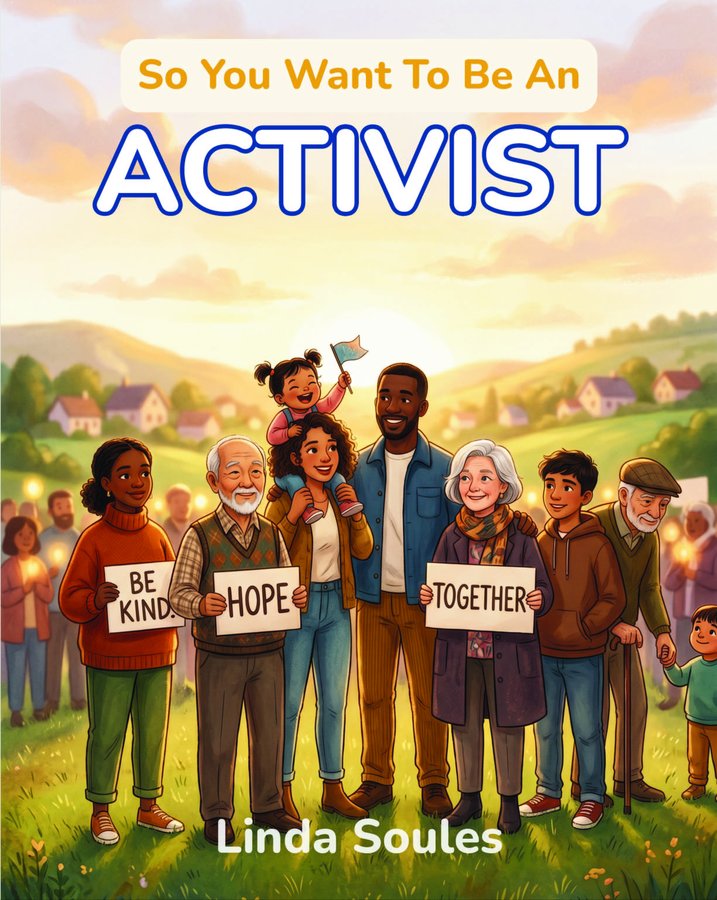
The judge's reasoning
This is a career-guide that refuses to condescend, and that refusal is its real achievement. Soules doesn't hand a ten-year-old a poster of a fist and a slogan — she hands them a spreadsheet, a phone tree, a folding chair in a church basement, and the specific, unglamorous mechanics of civic power. The 'Day in the Life' section (6:30 AM headlines, 12:30 PM cutting a testimony down to 270 words, 7:00 PM twenty-three people in a circle) does more to demystify activism than any inspirational montage could, and it trusts kids to find that texture interesting rather than boring.
The substance holds up under its own weight: the glossary distinguishes advocacy from lobbying from mutual aid with precision a lot of adult explainers fumble; the four activist profiles (Douglass, Maathai, Malala, Gandhi) are compressed but never hollow — 'you do not need permission, you do not need money, you do not need power. You need a seed, a piece of ground, and the willingness to begin' earns its inspirational weight because it follows fifty million actual trees. And the book is honest about cost in a way that respects its reader: burnout gets its own glossary entry, and the line 'There is no parade for the chemical leak that did not occur' names something true about this work that most kids' books about changemaking never touch. The closing 'Note From the Author' asks a genuinely hard question — 'am I even allowed to do this?' — and answers it with real constitutional grounding plus a caveat about telling a trusted adult. That's substance doing its job for the exact reader this book is for.

Judged by Brooke Hayes — Reader-at-Large · Cross-Genre · Emerging Voices
"Every book is the only book for somebody."
Supporting passages
"There is no parade for the chemical leak that did not occur because someone made forty phone calls in the right week."
A genuinely sophisticated point about invisible harm-prevention, delivered in plain language a child can actually hold onto.
"Their most common workspace is somewhere humble — a kitchen table covered in printouts, a borrowed church basement with mismatched folding chairs, the back room of a library, the porch of someone's house, or a long bench outside city hall while they await their turn to testify."
Concrete, sensory detail that makes the activist's actual daily world vivid rather than abstract.
"The activist who prevented it usually celebrates alone, with a cup of cold coffee and a quiet "huh — it worked.""
A small, precise, quietly funny image that carries real emotional weight for a middle-grade reader.
Per-axis rubric scores
Every Booky-winning book is scored across all ten craft axes. The award category comes from the top axis; a second axis at or above 75 appears as secondary recognition.
Find out what your book does best.
Submit your book today. Get a real, honest, category-specific Booky — or every dollar back.
Submit Your Book → Screen Another Book