
So You Want To Be A Zookeeper
by Linda Soules
MOST PAINTERLY PROSE BOOKY
Takes you to this book's Amazon page.
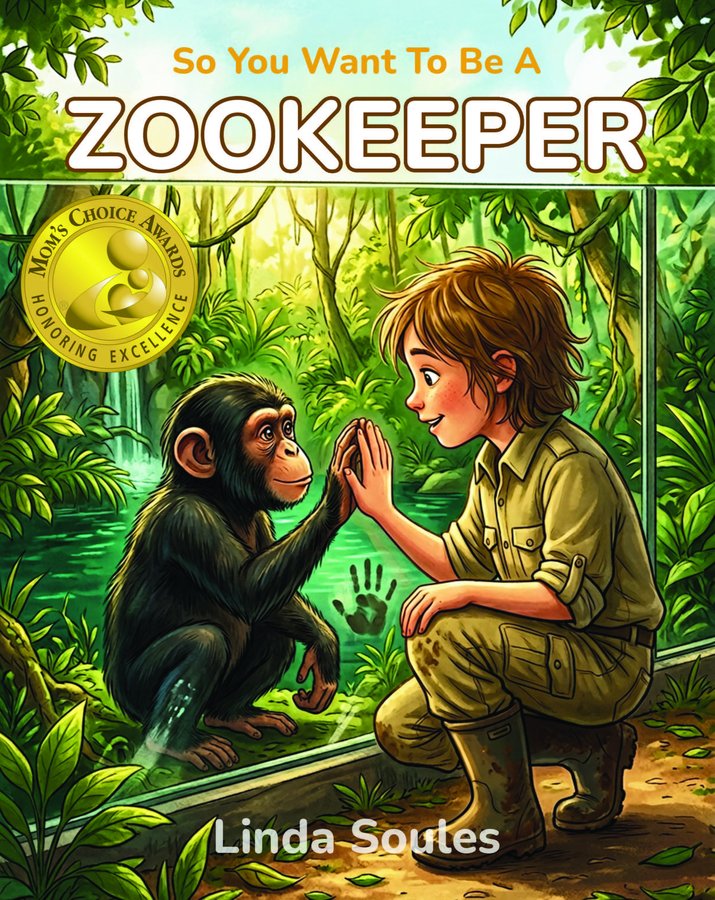
The judge's reasoning
So You Want To Be A Zookeeper earns its Booky first and foremost on the strength of its prose — which is, for a middle-grade nonfiction title, genuinely surprising. Linda Soules writes with the kind of precision and warmth that most adult narrative nonfiction would envy. The opening pages don't just describe the job; they put you inside it: "the paths quiet, the enclosures lit by early morning light, the sounds extraordinary: a low rumble from the elephant yard, birds calling from the aviary, the particular sharp smell of the big cat house as you pass." That's sensory writing that earns its details. It trusts a ten-year-old reader to feel atmosphere, not just receive information.
The prose never condescends, which is the cardinal sin of children's nonfiction and the one Soules consistently avoids. The section on behavioral observation — "A good zookeeper reads poop the way a doctor reads a blood test" — is a single sentence that does more than a paragraph could. The hardest-parts section earns genuine emotional weight: "The specific animal, the specific day, the specific silence in an enclosure that was not silent before." That's not filler. That's a writer who knows what rhythm can do.
The Author's Note closes the book with a moral argument that rises to the level of genuine essay: the claim that loving something without certainty of a happy ending is "a form of moral seriousness the world needs more of." A middle-grade reader who absorbs that sentence has been handed something real. This is a book that knows exactly who it's for — and meets them at full height.
Judged by Brooke Hayes — Reader-at-Large · Cross-Genre · Emerging Voices
"Every book is the only book for somebody."
Supporting passages
"the paths quiet, the enclosures lit by early morning light, the sounds extraordinary: a low rumble from the elephant yard, birds calling from the aviary, the particular sharp smell of the big cat house as you pass."
This opening description builds the world through specific sensory detail — smell, sound, light — showing a command of atmosphere rare in middle-grade nonfiction.
"The specific animal, the specific day, the specific silence in an enclosure that was not silent before. But the keepers who stay would rather feel that than not. Because the alternative is not caring — and nobody becomes a zookeeper to not care."
This passage achieves genuine emotional depth by grounding grief in concrete specificity rather than sentiment, modeling emotional intelligence for its young audience.
"there is a particular kind of moral courage in caring deeply about something that cannot thank you, cannot understand what you've sacrificed, and may not survive even with your best efforts."
The Author's Note elevates the book's theme from career guide to quiet moral argument, giving older readers something to carry long after the facts fade.
Per-axis rubric scores
Every Booky-winning book is scored across all ten craft axes. The award category comes from the top axis; a second axis at or above 75 appears as secondary recognition.
Find out what your book does best.
Submit your book today. Get a real, honest, category-specific Booky — or every dollar back.
Submit Your Book → Screen Another Book